Julie Rovner
KFF Health News
@jrovner
@julierovner.bsky.social
Read Julie's stories.
Julie Rovner is chief Washington correspondent and host of KFF Health News’ weekly health policy news podcast, "What the Health?" A noted expert on health policy issues, Julie is the author of the critically praised reference book "Health Care Politics and Policy A to Z," now in its third edition.
Senate Democrats hope a little-used law from the 1990s will help draw attention to the healthcare cost issue by forcing a vote on the Trump administration’s recent changes to the Affordable Care Act.
Meanwhile, Health and Human Services Secretary Robert F. Kennedy Jr. is demanding information from a medical journal that retracted a study that backed Kennedy’s claims of vaccine harm.
This week’s panelists are Julie Rovner of KFF Health News, Anna Edney of Bloomberg News, Sheryl Gay Stolberg of The New York Times, and Lauren Weber of The Washington Post.
As the midterm elections approach, congressional Democrats are pushing back on newly finalized guidelines from the Trump administration for ACA plans. The guidelines allow the sale of plans with fewer benefits and bigger deductibles next year, further eroding protections designed to keep healthcare affordable. With many voters concerned about the cost of care, Democrats’ push could prove a potent campaign message come November.
State officials in Texas and Alabama are continuing to crack down on abortion access. And new reporting reveals a trend of women going to great lengths to seek abortion care only to learn that their home pregnancy test results were false positives and they’re not pregnant.
Two medical journals recently retracted separate studies that linked vaccines to harmful health problems, with Kennedy pushing back. And legal action over Kennedy’s reconstituted vaccine panel and its decisions is leaving the nation without traditional outside expert input into seasonal vaccines as the flu season approaches — though the American Academy of Pediatrics has pointed out that Kennedy could resolve the legal issues by simply appointing experts to the panel with vaccine backgrounds, as statute dictates.
Also this week, Rovner interviews Michael Cannon of the Cato Institute and Liz Fowler of the Johns Hopkins Bloomberg School of Public Health about their joint effort pushing for the elimination of the employer health insurance tax exclusion. You can read their Washington Post op-ed here.
Plus, for “extra credit” the panelists suggest health policy stories they read this week that they think you should read, too:
KFF Health News is a national newsroom that produces in-depth journalism about health issues and is one of the core operating programs at KFF—an independent source of health policy research, polling, and journalism. Learn more about KFF.
In a move that mixes pure politics with weedy congressional procedures, Senate Democrats are seeking to force a vote to overturn a Trump administration rule that they say will make it harder to enroll in Affordable Care Act health plans and sharply raise out-of-pocket costs for those who do.
The measure is unlikely to pass in the Republican-controlled Congress, but Democrats could use the vote against their opponents on the campaign trail.
When the ACA rule was released in May, the Trump administration touted it as a means to combat enrollment fraud, lower premiums for some people, and offer a wider range of insurance plans, including ones with no set network of doctors or hospitals.
But many Democrats warned the changes would hurt consumers already suffering from high healthcare costs as well as higher prices for gas, groceries, and other household needs. Estimates from the administration found the regulation, called a notice of benefit and payment parameters, could cause up to 2 million people to lose ACA coverage.
Senate Minority Leader Chuck Schumer and fellow Democratic Sens. Tammy Baldwin of Wisconsin and Ron Wyden of Oregon plan to introduce on Wednesday a Congressional Review Act resolution to block the rule.
Baldwin told KFF Health News in a statement that the rule is “misguided” and said she was “committed to doing everything she can” to stop Republicans from “kicking Americans off their health care.”
The directive from the Centers for Medicare & Medicaid Services is an annual exercise that sets standards for ACA coverage during the coming year. Some of the changes in the finalized 2027 rule are technical, but many would affect consumers directly.
They include tighter income verification requirements. The rule also stipulates more eligibility checks on people applying outside of the normal annual enrollment period for such reasons as marriage, divorce, or loss of job-based coverage.
ACA plans themselves would look different too. Insurers would be able to offer some plans with 30% higher out-of-pocket limits (the amount consumers may have to pay each year in cost sharing such as copayments and deductibles), with a new ceiling as high as $15,600 for individual coverage or $31,200 for a family plan.
The Democrats’ effort to overturn the rule is the definition of a long shot; it would need a majority of votes in both the House and the Senate. But simply forcing a floor vote is likely to be seen as a win by the minority party.
“What Democrats are trying to do is get Republicans to vote on policies that would be unpopular if they rose to the level of public consciousness,” said Adrianna McIntyre, an assistant professor in the Department of Health Policy and Management at the Harvard T.H. Chan School of Public Health. “Democrats want to showcase that they want to change these policies, even if don’t have the votes to accomplish it.”
Congress has authority under the review act — enacted as part of a larger law in 1996 — to overturn rules issued by federal agencies. While more than 40 such disapproval resolutions have passed, hundreds have been introduced, often mainly to draw attention to an issue.
It is one of the few levers a minority party has to force action on the floor of the Senate.
That’s because if only 30 senators sign a discharge petition to send the measure to the floor, the Democrats get a vote, without needing to go through a Republican-controlled committee or hold a hearing. A companion resolution is expected to be introduced in the House on June 17.
And there’s no doubt that Democrats will try to use any floor vote on health costs as a litmus test for Republicans in the November elections.
“Time and again Democrats have used Republican efforts to undermine the ACA to their political advantage in campaigns, and this year will be no different,” said Larry Levitt, executive vice president for health policy at KFF, a health information nonprofit that includes KFF Health News.
Polls show that the GOP could be vulnerable if Democrats can convince voters their party would do better on health costs, which are a top concern among voters.
A recent Pew poll, for example, found that 73% of adults see healthcare costs as a very big problem for the country, leading both inflation and the federal budget deficit. KFF’s tracking polls have found healthcare costs to be a top concern, even among Make America Healthy Again supporters allied with President Donald Trump.
At least half of people who identify as MAHA voters say those health costs will have a “major impact” on their decision to vote and which party they support.
Medical costs in general typically rise faster than inflation, driven by increased hospital and doctor bills and use of drugs, devices, and other healthcare. That leads to higher costs for employers that offer health plans to their workers and for taxpayer-supported programs such as Medicare and Medicaid, as well as higher premiums for insurance plans sold under the ACA. The consultancy PwC projects the cost to treat patients this year will rise by 9%, the highest in nearly two decades.
Higher premiums and lower subsidies also hit many ACA enrollees this year, with about 1.2 million fewer sign-ups than for 2025 as of January.
Costs “are a good Democratic talking point,” said Joseph Antos, a former government health official who is now a senior fellow emeritus at the right-leaning American Enterprise Institute. “Trump was going to solve inflation, and instead, what do we have?”
KFF Health News is a national newsroom that produces in-depth journalism about health issues and is one of the core operating programs at KFF—an independent source of health policy research, polling, and journalism. Learn more about KFF.
In Maine, state health officials hoped to steer a slice of $190 million in new federal rural health funding to shield hospitals and clinics from the fallout caused by cuts to federal health programs.
Their plan would have helped pay to treat low-income, uninsured patients.
But federal leaders overseeing the five-year, $50 billion Rural Health Transformation Program said no.
“It was not our decision,” said Lisa Letourneau, a senior adviser at Maine’s health department.
Letourneau told an audience of healthcare providers, advocates, and community groups during a March webinar that the change was “disappointing.”
Maine isn’t alone in having to make changes to plans pitched to win a share of the Trump administration’s new rural health fund.
Centers for Medicare & Medicaid Services Administrator Mehmet Oz praised states’ plans when announcing the rural health program awards last year and said his agency would help states “turn their ideas into lasting improvements for rural families.”
But state officials and healthcare leaders said it’s also clear the agency wants to encourage specific policy changes and hold states accountable to the promises they made and rules they agreed to follow.
During the past six months, as states raced to meet the program’s looming federal deadlines, CMS staffers worked with state health departments to make a flurry of changes, including scrapping some initiatives. The federal agency has the power to rescind existing funding — or reduce future awards — if states don’t follow rules or meet their goals. “We will take the money back” if states “don’t abide by what they wrote, if they don’t do a good job,” Oz said at an event this month in Washington, D.C.
Congressional Republicans created the Rural Health Transformation Program as a last-minute sweetener in their One Big Beautiful Bill Act last summer. The funding was intended to offset concerns about the outsize fallout anticipated in rural communities from the law, which is expected to reduce Medicaid spending by more than $900 billion over a decade.
Read an excerpt from the One Big Beautiful Bill Act.
MISUSE OF FUNDS.—If the Administrator determines that a State is not using amounts allotted or redistributed to the State under this subsection in a manner consistent with the description provided by the State in its application approved under paragraph (2), the Administrator may withhold payments to, or reduce payments to, or recover previous payments from, the State under this subsection as the Administrator deems appropriate, and any amounts so withheld, or that remain after any such reduction, or so recovered, shall be returned to the Treasury of the United States.
On a call with reporters in December, Oz said “one of the smartest things the president and Congress” did when creating the program was to create a threat of “clawbacks,” or taking money back if states don’t do what they promised in their applications.
Oz went on to describe how the clawback mechanism gives governors leverage to press their legislatures to adopt the Trump administration’s priorities, such as instituting the presidential fitness test in schools.
“This gives you extra umph, a little bit of gusto to go after these issues,” he said.
That message was received loudly and clearly in Tennessee. Michael Hendrix, policy director for the governor’s office, said during a hearing that federal officials said the state “would be more competitive for more funding through policy change.” He said CMS also relayed that “some share of this year’s funding, if policies are not implemented, might be clawed back.”
The threat of rescinding funding has caused fear and confusion among health organization leaders, said Alan Morgan, CEO of the National Rural Health Association.
“We’re worried that facilities and organizations won’t apply for the grant money because of the fears of the clawbacks,” he said, adding that he would like the administration to clarify if federal officials could take back grant money that states have already awarded to rural health organizations.
While clawbacks are a “necessary, important tool” to address misuse of funds and ensure the money goes toward helping rural communities, they are also “a dangerous tool,” said Morgan, whose organization represents rural hospitals and clinics.
CMS did not respond to multiple requests for comment.
States must file progress reports by the end of August. They then have until Oct. 30 to commit their first-year funding and Sept. 30, 2027, to spend it.
States are progressing at wildly different rates, with some still developing grant applications and others already distributing money, according to a tracker created by Morgan’s rural health association.
In late January, Iowa became the first to award funding. The tracker shows that most states have opened grant applications, but 11 others, including Wyoming, Maine, and Colorado, have yet to post any funding opportunities.
CMS’ tight control over state programs is one reason for such disparity in progress.
Instead of typical grants, the rural health program uses cooperative agreements, which require a back-and-forth partnership, said Charlie Sagona, a grant specialist at Assel Grant Services, a consulting firm that helps organizations manage grants.
“You are going to be working very, very closely with them; things will ebb and flow and change and move,” said Sagona, who is helping several large hospital systems interested in winning some of the rural funding.
Kate Sapra, deputy director of CMS’ Office of Rural Health Transformation, said at a May event that the agency has “many avenues of oversight.” Staffers are tracking applications for state funding and “looking to see when contracts are executed,” she said.
Sapra said the agency wants to “have conversations with states before they get to the point” of putting out something that’s not allowed. It’s “really important to us” for the funding to reach rural providers, she added.
Sapra said her office has filled about half of 30 new slots for project officers. The officers and the states check in “at least twice a month, if not on a weekly basis.”
Vermont Medicaid Director Jill Mazza Olson, who led her state’s rural health application, said the officers are “very responsive.”
Vermont is one of the states that had to ditch or tweak its plans. Olson said the state pulled its plan to increase housing for rural healthcare workers after federal officials said they would evaluate the proposal based on the agency’s guidelines for construction projects at healthcare facilities. Those rules allow only “minor” renovations to existing buildings or campuses.
In Colorado, state leaders changed grant eligibility rules after they “received feedback” from CMS and healthcare providers, said Marc Williams, a spokesperson for the state’s Department of Health Care Policy and Financing.
Wyoming legislators and state officials spent months designing, discussing, and voting on a plan to invest most of its award into a perpetuity fund that could have generated $28.5 million for the state to spend every year, “forever,” according to materials presented to lawmakers.
The state had to pull the idea because it “was a degree too innovative for CMS to swallow,” said Republican state Sen. Charles Scott, a veteran lawmaker and cattle rancher. “This whole thing has been a bit of a disappointment to us in Wyoming.”
Stefan Johansson, director of the state’s health department, said Wyoming’s final spending plan wasn’t approved until mid- to late May. He said the department hopes to begin awarding money in late summer or early fall.
“Make no mistake — it is a very compressed timeline,” he said.
Across the country, Maine was forced to rework its plan to reimburse hospitals and clinics when they provide “essential” care to certain uninsured patients.
Letourneau said during her March remarks that federal officials rejected this idea because “provider payments had to be more directly linked to a rural transformation kind of activity.”
Lindsay Hammes, a spokesperson for Maine’s health department, told KFF Health News that funding will instead help providers transition to reimbursement models that aren’t based on how many patients they treat.
Reworked plans call for spending $28.5 million to support providers, Letourneau said in March.
“But there definitely will be more strings attached.”
KFF Health News correspondent Darius Tahir contributed to this report.
KFF Health News is a national newsroom that produces in-depth journalism about health issues and is one of the core operating programs at KFF—an independent source of health policy research, polling, and journalism. Learn more about KFF.
The issue of affordability has reignited a long-simmering battle between California’s medical industry and one of its largest health worker unions.
SEIU-United Healthcare Workers West, with approximately 120,000 members, has put forward two ballot initiatives to cap the pay of medical executives and require community clinics to spend the vast bulk of their revenues on patient care.
The California Hospital Association has responded with its own ballot proposal that would make it tougher for unions to spend money on future political initiatives by requiring a union’s rank-and-file membership to approve any spending of at least $1 million on statewide measures or $100,000 on local ones.
The competing measures, which have drawn enough verified signatures to qualify for the November ballot, come at a time when the rising cost of healthcare is emerging as a top voter concern.
The Service Employees International Union affiliate has seized upon affordability angst to resurrect failed proposals to cap healthcare executive compensation.
Mikey Vaughn, a certified nursing assistant at Cedars-Sinai Medical Center, said that the Los Angeles hospital, despite its reputation as the go-to place for the rich and famous, often lacks supplies and staffing that he and his colleagues need to do their jobs.
But that’s not how hospital officials see it. Cedars-Sinai spokesperson Duke Helfand said if the measure passed, the hospital would be unable to recruit and retain physicians, nurses, and specialists, dramatically impairing its ability to provide healthcare.
The union wants to cap compensation at $450,000 a year for senior hospital and medical group executives, as well as other administrative and managerial staff. SEIU-UHW does not have an estimate of the amount the initiative would claw back from pay packages that exceed the limit. And the initiative does not stipulate how dollars diverted from payroll must be spent.
Carmela Coyle, CEO of the hospital association, called the measure a cynical political ploy.
And Glenn Melnick, a healthcare economist at the University of Southern California, said that even if the initiative were fully implemented, he doubts it would reduce patients’ healthcare costs.
The second SEIU-UHW ballot initiative, on community clinics, is already in court. The California Primary Care Association, which represents clinics, filed a federal lawsuit in April seeking to invalidate it before it reaches the November ballot.
One of California’s largest healthcare unions is sponsoring two initiatives that would regulate community clinics and cap executive and managerial pay at hospitals and physician groups. In the most recent eruption of a long-standing feud, the measures have drawn fierce opposition from a wide swath of the medical industry.
KFF Health News is a national newsroom that produces in-depth journalism about health issues and is one of the core operating programs at KFF—an independent source of health policy research, polling, and journalism. Learn more about KFF.
President Donald Trump, who once declared he had “saved” flavored vapes, grew his stock holdings this year to as much as $1.64 million in tobacco giant Philip Morris.
He also had holdings in Altria and a third leading tobacco company, though an apparent discrepancy in his disclosures clouds the extent of his investments. In 2025, tobacco interests donated $6 million to MAGA Inc., a super PAC that supports the president, and Trump’s inauguration. And, on April 30, a week before FDA guidance that provided a critical boost to the industry, Reynolds American dropped an additional $5 million into the super PAC’s coffers.
The stock trades and political contributions occurred as the Trump administration pursued a broadly pro-tobacco agenda: Its FDA piloted a fast-track program to approve nicotine pouches. It unveiled a program to allow vapes on the market more rapidly, despite resistance from career civil servants and leadership, culminating this year in guidance waving through flavored electronic cigarettes. It cut public health employees focusing on anti-tobacco policy. And it broadened enforcement against illicit e-cigarettes, competitors to the big industry players with a financial relationship to Trump.
It amounts to the most pro-tobacco, pro-nicotine presidency in some time — a remarkable policy given the tens of millions of deaths cigarettes caused during the 20th century. Even in recent years, anti-smoking groups say a half-million Americans a year die from cigarettes. Industry advocates say the toll helps justify a shift to e-cigarettes and nicotine pouches, which they say are less harmful. However, public health advocates say these products carry their own risks, such as addiction.
Lawmakers and public health leaders have criticized the recent FDA guidance and approvals as a “lucrative payday” that ignored scientific evidence to deliver what investment analysts have described as “very positive” steps for influential tobacco companies.
The scale of the money is “unprecedented and problematic,” said Brian King, who was pushed out of the FDA’s tobacco office last April and now works as an executive at the Campaign for Tobacco-Free Kids. He fears that steering public policy toward tobacco — still addictive and harmful to health — puts Americans at risk.
“It’s a gift on a platter with a side of public health malpractice,” he said.
The White House did not comment on the president’s investments or industry donations to MAGA Inc. Spokesperson Kush Desai said, “The only guiding factor behind the Trump administration’s health policymaking is Gold Standard Science. FDA’s regulatory treatment of nicotine pouches and vapes is rooted in recent evidence that has found that these products can help adults quit smoking.”
Philip Morris disputed any connection. Company representatives “regularly attend events and forums where we share our commitment to improving public health in the United States,” spokesperson Samuel Dashiell said, arguing that the company’s vapes offer a safer alternative to smoking cigarettes. “We do not comment on individual engagements or on the personal financial matters or disclosures of public officials.” Other tobacco companies whose stock Trump has bought and sold during his second term or that donated to groups aligned with Trump — Juul, Reynolds American, and Altria — did not respond to requests for comment.
The financial stakes are huge. Investment analysts at Goldman Sachs say the newer products, touted as safer, make more money per sale than traditional cigarettes. Philip Morris expects Zyn pouches, for example, to make eight times the gross profits of its cigarettes, Goldman Sachs analysts said in March 2025.
When he ran for his second term, Trump promoted himself as a pro-tobacco candidate, posting that he had “saved” flavored vaping and that President Joe Biden and Democratic nominee Kamala Harris “want everything banned.”
Since late 2023, MAGA Inc. has received over $20 million in funding from the industry, federal campaign records show. Trump’s inauguration garnered nearly $4 million more. His ballroom project has disclosed donations of an unknown amount from Altria and Reynolds American.
Recent Trump administration actions show he’s followed through with his campaign rhetoric. In May, the FDA released consequential guidance that allows manufacturers to market their vapes and nicotine pouches while awaiting agency approval. It also approved several vaping products. The month before, the Vapor Technology Association, which donated $1.25 million to Trump’s inauguration, told its vape-manufacturer members it had met with the White House to discuss its concerns.
By that point, Trump had gone on a stock-purchasing spree. In March he made eight separate purchases of Philip Morris or Altria stock, worth as much as $275,000, according to a disclosure form that bears Trump’s signature.
It is difficult to be precise about Trump’s tobacco investments, because the financial disclosures show only ranges of investment amounts. They also have an apparent discrepancy. In January, the president sold $500,000 to $1,000,000 in Altria stock. But that’s confusing because previous disclosures didn’t show Trump held that much equity in Altria. The White House declined to comment on the matter.
The FDA’s May guidance and approvals drew condemnation from public health leaders, who worry that the agency is allowing products with flavors especially appealing to young people. “After years of recognizing the dangers flavored e-cigarettes pose to youth, it is deeply troubling to see FDA ignore the scientific evidence and reverse course,” American Lung Association CEO Harold Wimmer said in a published statement.
“I think it’s blatantly illegal, both on its merits and also procedurally, because it was issued as a final guidance without even giving the public an opportunity to comment on it,” said Mitch Zeller, a former head of the FDA’s tobacco center.
A group of Democratic senators called the decision a “a free pass to addictive and harmful vapes” in letters to Reynolds American and Altria. It would lead to “a lucrative payday after years of unsuccessful legislative and regulatory efforts to weaken federal tobacco oversight,” they concluded.
Members of Congress are barred from insider trading, and many legislators would like to see trading of individual company stocks banned for all members. In the wake of Trump’s most recent financial disclosures, with revelations that he often traded in companies manufacturing GLP-1 drugs before his administration steered policy in a favorable direction, some members are calling for the president, too, to be barred from stock trading.
Trump’s tobacco policies have garnered favorable grades from investors. At Goldman Sachs, bankers described the May FDA guidance as “very positive” for Philip Morris and “a significant step in the FDA’s positioning toward enforcement and acceptance of nic pouch (as well as e-vapor) innovation generally.”
And Barclays analysts said the FDA’s guidance was good news for Juul, a leading vape producer. (In November, the company contributed $1 million to MAGA Inc.)
FDA resistance to speeding up approvals for these products reportedly contributed to the ouster of agency commissioner Marty Makary, who did not respond to requests for comment. According to The New York Times and The Wall Street Journal, the White House repeatedly intervened in the approval process.
“I served during the entire first Trump administration as center director, and there was never any pressure from any political appointee at FDA, at HHS, or the White House when it came to application review,” Zeller said.
But recent changes in FDA policy can be traced to the access tobacco firms have had to the White House, he said.
By and large, the Trump administration has delivered on industry priorities. Soon after the inauguration — which tobacco companies had donated heavily to — the administration withdrew a Biden-era proposal to ban menthol cigarettes. The administration has eased the path for nicotine pouches such as Zyn. Investment analysts viewed government crackdowns on illicit e-cigarettes positively: Barclays wrote in January that “company commentary on enforcement has also been upbeat, suggesting that the tide could begin to turn in favour of the legal players in the market.”
What’s more, the Trump administration’s government layoffs have decimated public health’s tobacco control offices. The work of the Centers for Disease Control and Prevention’s office of smoking has been sharply curtailed; its flagship “Tips From Former Smokers” campaign, which seeks to persuade viewers not to smoke, has been off the air for months, King said.
“It’s not difficult to see that less dollars invested in prevention and control is going to lead to more tobacco product use and tobacco-related disease,” King said, especially given the government’s decades-long success in reducing cigarette usage.
The shift is particularly ironic given the administration’s focus — through its Make America Healthy Again slogan — on chronic disease. “Attempting to combat chronic disease without tobacco control is like attempting a triathlon without a bicycle: You are destined for failure before leaving the starting line,” King concluded.
KFF Health News is a national newsroom that produces in-depth journalism about health issues and is one of the core operating programs at KFF—an independent source of health policy research, polling, and journalism. Learn more about KFF.
Officials, environmental health advocates, and skin care industry groups are expressing hope that the Food and Drug Administration’s approval of a sunscreen ingredient on June 9 — after consideration for two decades, and global use for nearly as long — will help restore Americans’ wavering faith in sunscreen.
“Bemotrizinol has been used safely in Europe for decades,” Health and Human Services Secretary Robert F. Kennedy Jr. said in the announcement about the approval. “FDA’s action will increase competition and consumer confidence in sunscreen products.”
Nonprofits that advocate for health, such as the Environmental Working Group, and the skin care industry alike had lobbied for approval of the ingredient, which makes sunscreens sheerer and lighter on the skin than many available American options while blocking a wider spectrum of ultraviolet rays that can cause premature aging and skin cancer.
The newly approved sunscreen filter will allow companies to reformulate sunscreens to address consumers’ concerns, said Carl D’Ruiz, a senior manager at DSM-Firmenich, a Swiss maker of sunscreen chemicals that applied for the FDA approval. In addition to allowing companies to offer what the FDA calls safe and effective formulations, he said, the approval will allow sunscreens that are more like sought-after South Korean brands to be sold in the U.S. by autumn.
Confidence in U.S. sunscreen has faltered on two fronts: among those concerned about what’s in the sunscreens they use and those who believe sun exposure is healthy. But will the new ingredient win the trust of Make America Healthy Again skeptics and Gen Zers intentionally tanning? RFK Jr., strikingly bronzed, has helped stoke this confusion by pledging in 2024 to fight what he called the FDA’s “war on public health” and “aggressive suppression” of sunshine. Under his leadership, the FDA backed away from a plan in March to ban people under 18 from using tanning beds.
All this matters because 1 in 5 people will develop skin cancer by age 70 in the United States. It is the most common cancer in the nation, where about 3.3 million people are diagnosed each year with basal and squamous cell carcinomas.
D’Ruiz said he thinks bemotrizinol, also known as BEMT, will change the dynamic. “People will talk more positively about sunscreens,” he said.
In the U.S., new sunscreen chemicals are regulated as over-the-counter drugs like aspirin or cough syrup rather than as cosmetics, as in Japan and the European Union. That means they face more elaborate testing and safety protocols, such as animal testing that runs afoul of EU laws, which is why the approval process for bemotrizinol took nearly two decades, D’Ruiz said.
What’s “generally recognized as safe and effective,” otherwise known as “GRASE” in FDA-speak, is at the center of the American sunscreen debate. Bemotrizinol joins zinc oxide and titanium dioxide on the FDA’s GRASE list.
That could help rebuild trust, said Alexa Friedman, an environmental epidemiologist at the Environmental Working Group, a nonprofit that researches the ingredients in consumer products.
“It has strong safety data,” Friedman said. “The documents submitted to the FDA to achieve ‘generally recognized as safe and effective’ include tests of irritation, sensitization to allergies, two-year animal studies for carcinogenicity, and reproductive health.”
The approval will also give consumers access to sunscreens that don’t leave as much of a white cast, she said, which makes some people hesitant to use mineral sunscreens such as zinc oxide and titanium dioxide.
Bemotrizinol’s approval won’t change the possibility of several chemicals with unclear safety profiles being added to sunscreens.
In 2019, the FDA said there was insufficient data to support a positive “generally recognized as safe and effective” determination for 12 commonly used sunscreen chemicals.
The concerns emerged after the FDA published a study that said some sunscreen ingredients had been found in humans’ bloodstreams. Though the industry has since phased out several of those chemicals lacking GRASE status, four are still widely used: avobenzone, homosalate, octisalate, and octinoxate.
“The European Union had recently concluded that homosalate was not safe at concentrations that they were using and recommended a very low percentage — which was effectively a ban,” Friedman said. “The U.K. also issued a safety evaluation.”
Octisalate and octinoxate have been associated with disruption of the endocrine system, and octinoxate was banned for sale in Hawaii due to concerns that it harms marine life and bleaches coral reefs.
Avobenzone breaks down when exposed to light, making it less effective, Friedman said, and has been associated with allergic reactions.
Mark Mitchnick, a pediatrician who invented transparent zinc oxide, which is known under the brand Z-Cote, said bemotrizinol will give chemists a new tool to make sunscreens that people will want to wear.
“It’s a good UVA block,” he said. “It gives us good flexibility. In my mind, it allows you to make really good products without using avobenzone, which I think has a lot of baggage.”
Most of the UV rays people are exposed to are UVA rays that can penetrate the middle layer of the skin and cause up to 90% of skin aging, along with a smaller amount of UVB rays, which are responsible for sunburns. Ultraviolet radiation falls on the electromagnetic spectrum between X-rays and visible light.
Mitchnick said major companies have used chemical filters because they work better on a per-pound basis compared with mineral sunscreens made with zinc oxide and titanium dioxide. “That’s why hybrids are great — you get the best of both worlds.” He said he expects companies, including his own, to release hybrid products containing bemotrizinol and zinc oxide later this year.
J. Frank Nash, a senior director and research fellow at Procter & Gamble, said skepticism about sunscreen is unfortunate because properly formulated sunscreens do an excellent job blocking solar UV, “which we know is responsible for skin cancers and aging.”
He worries the industry has contributed to the trust gap by adding unapproved UV filters, called boosters, to mineral sunscreens, to raise sun protection factor ratings, or SPF. This leads consumers to wonder what’s in the products they’re buying.
Still, in Australia, where bemotrizinol has been used in sunscreens for years, a recall scandal over ineffective products shows that even when regulators allow lauded UV filters, bad actors can taint a whole industry.
“People are not shunning sunscreen because they have stopped believing UV is dangerous,” said Joseph Mizikovsky, a director of the Australian Sunscreen Council. “They are shunning it because they have lost trust in what is in the bottle.”
He applauds the FDA’s transparency with American consumers about the lack of safety data for filters without GRASE status, and FDA’s insistence on mandatory microbial testing of products.
But he said the FDA could do more to rebuild trust in sunscreens.
“My view is the FDA should move faster to ban filters that are missing safety data, and the public should focus on physical protection — shade, clothing, hats, sunglasses — with sunscreen as the last layer, not the first.”
KFF Health News is a national newsroom that produces in-depth journalism about health issues and is one of the core operating programs at KFF—an independent source of health policy research, polling, and journalism. Learn more about KFF.
SALT LAKE CITY — Ben Dowse hadn’t expected to treat measles when he became a doctor, but there he was, examining a newborn exposed to the virus in the womb. The infected mother had given birth just hours earlier. The hospital had alerted Dowse to the case before delivery, and he’d braced himself for the worst.
Dowse wore a full-body protective suit with a plastic face mask. As a pediatrician in southern Utah, he couldn’t risk getting even a mild infection, because many of his patients are babies too young for measles vaccines or children whose parents choose not to protect them with immunizations. “I went in looking like a scientist in E.T.,” he said.
Measles can cause brain damage, deafness, or death in newborns. If the baby entered the world with a measles rash and fever, Dowse was prepared to give the infant a spinal tap to assess the risk of neurological damage.
Luckily, flushed and crying, the baby looked healthy. To keep it that way, Dowse wanted to inject the baby with concentrated antibodies against the measles virus. To his surprise, the parents objected, promising to give their child “all kinds of vitamin A,” Dowse said. He begged them not to, saying, “You can’t see it on the surface, but the baby’s body is fighting the measles.” They were afraid of vaccines, so Dowse explained that antibodies were different and that they would stop measles from replicating in the infant.
“That shot is going to basically give the baby ammo to fight,” Dowse said.
The parents relented. A couple of days later, they left the hospital with a child who had narrowly skirted an infection that killed many thousands of babies a century ago. Nonetheless, Dowse said he doubted they would be returning for childhood vaccinations to protect their baby against a bevy of illnesses. Like more than a dozen Utah doctors and health officials who spoke with KFF Health News, Dowse has adjusted his expectations.
He is part of a reluctant cohort of medical professionals now on the front line of America’s regressive next chapter in health history, one in which dangerous and preventable diseases return.
“I wish that people could see what I see,” said Nathan Money, a hospital pediatrician in Utah whose eyes welled up with tears as he described children he’s treated for measles struggling to breathe. “This train is going in the wrong direction, and it can feel like a helpless situation, because we’re just not seeing the public messaging and leadership that’s needed to turn this around.”
Since measles was deemed eliminated in the U.S. a quarter century ago, public health workers have extinguished sporadic outbreaks in close-knit, undervaccinated communities with targeted methods: Isolate people with measles and quarantine their contacts to contain the virus. But as vaccination rates drop nationwide, the virus is moving beyond insulated communities, overwhelming public health departments constrained by shoestring budgets. Larger outbreaks, the kind not seen for a generation, have forced health officials into a new paradigm: They have stopped racing to “contain” infections and shifted gears into what they call “mitigation.”
Utah made that transition early this year, once the outbreak hit “a point where you no longer have control over it,” said state epidemiologist Leisha Nolen. By March, measles had been detected in every health jurisdiction in the state and in northern Arizona. More than 950 people have tested positive in the two states since the outbreak began in August, but many people with measles haven’t been tested. A genetic analysis of measles viruses suggested that the true number of cases last year could have been 6.5 times what was known.
Last year under President Donald Trump, U.S. measles cases exceeded 2,000 for the first time since 1992. Six months into 2026, the U.S. has already surpassed that threshold. Prolonged outbreaks exact a toll on children, who have spent days in hospitals for severe infections and missed weeks of school for mild ones. Adults with measles miss work. Parents delay daycare to keep their babies safe. Doctors in Utah have enacted labor-intensive protocols to keep measles from spreading in clinics. Newborns and people with weakened immune systems who have been exposed to the virus receive infusions of concentrated antibodies costing $500 to $1,000. Medical visits for measles can costmore than $33,000 per patient. Health departments spend millions trying to curb infections.
Emilie Morris, a hospital pediatrician in Utah, has cared for multiple unvaccinated children who were severely sick with measles. She’s learning how to communicate with parents who hadn’t expected the virus to cause so much harm. (Amy Maxmen/KFF Health News)
“This is like a snowball that gathers speed as it rolls downhill,” said Emilie Morris, a hospital pediatrician in Salt Lake County and Utah County. A full-throttle campaign to educate communities on the safety of vaccines and the diseases they prevent could turn the situation around, doctors and health officials said. It would require an effort similar to what the anti-vaccine movement has long done in videos, blogs, and podcasts. For example, the anti-vaccine organization that Robert F. Kennedy Jr. founded before taking the helm at the Department of Health and Human Services, Children’s Health Defense, visits vaccine-hesitant communities, produces movies, and has bought advertisements on Facebook that downplay the threat of viruses while wildly exaggerating the risk of vaccine side effects. Kennedy’s words and actions as health secretary are adding to parents’ doubt.
After the development of vaccines and antibiotics in the mid-1900s, virologist and Nobel laureate Frank Macfarlane Burnet wrote, “One can think of the middle of the twentieth century as the end of one of the most important social revolutions in history, the virtual elimination of the infectious diseases as a significant factor in social life.”
He couldn’t have imagined what was coming.
‘Year of Sickness’
A view of St. George, a city in southwest Utah that’s been hit hard by an ongoing measles outbreak that started in August. Nearly 40% of the state’s cases have occurred in the region. (Amy Maxmen/KFF Health News)
In communities nestled among the red sandstone cliffs and riparian forests of southern Utah, measles took hold last summer. At the main school in Hildale, a town along the Arizona border, just 30% of kindergartners are considered adequately immunized by Utah’s health department, meaning they’ve gotten recommended vaccines against measles, tetanus, polio, and more. Exemptions from childhood vaccine requirements are easily acquired in the state: Parents need only claim personal, religious, or medical reasons.
Many people in Hildale and the surrounding towns are connected to the Fundamentalist Church of Jesus Christ of Latter-Day Saints, a sect that has been leery of the government since a police raid in 1953 separated polygamous parents from their children. Shirlee Draper, a southern Utah resident who grew up in the faith, said they became ever more isolated in the early 2000s under the leadership of Warren Jeffs. Before he was sentenced to life in prison for sexual assault against minors, Jeffs instructed his followers to withdraw from public schools and mainstream medicine.
“Growing up, we all got our vaccines,” said Draper, who left the group during Jeffs’ reign. “It wasn’t until Warren Jeffs came along that there started to be more and more resistance.”
After Jeffs went to prison, many people left the faith but remained concerned about vaccines because of online misinformation, such as claims that the shots are toxic. Today a small shop in Hildale sells mouth sprays and oral drops professing to detoxify vaccines. Water, glycerin, and “whole grain alcohol” are listed as ingredients in one called Vxx-Dtx.
A mother who KFF Health News agreed not to name, because she fears stigmatization, said she considered getting her kids vaccinated when schools in southwest Utah started seeing measles cases last summer. She had split from the fundamentalist group but still worried about vaccines giving her children autism or other complications. Largestudiespublished in top-tier scientific journals have refuted a link between vaccines and autism, but the anti-vaccine movement has kept the notion alive.
Then the woman’s son told her that his classmate had a rash and spit on him, she said. A few days later, he fell ill with a fever, followed by vomiting, diarrhea, and a head-to-toe rash.
“He felt downright sick for 10 to 14 days,” the woman said. “It was hard to see the end of the tunnel.”
Then her daughters came down with measles. She had a fleeting case, too, even though she had been vaccinated as a child. Breakthrough infections tend to be mild and are relatively rare. Only 4% of 4,300-plus U.S. cases reported this year and last have been people who’ve had two doses of the measles, mumps and rubella vaccine.
By the time the family recovered, the son had missed nearly three weeks of school, the daughters a month, and the mother had postponed an important family gathering because she didn’t want to spread infections. “I just got my youngest’s missed-school report and it’s super high,” she said. “This is the year of sickness.”
The Southwest Utah Public Health Department stocks vaccines against measles, whooping cough, tetanus, hepatitis B, and other diseases. (Amy Maxmen/KFF Health News)
The woman said she regretted not getting her kids vaccinated when the outbreak started. She said she knows about 30 people who have fallen sick with the measles. Except for a few who needed medical care, they haven’t been tested. “I bet there’s been thousands of cases,” she said.
Measles doesn’t have a cure. She and others have tried to ease symptoms with cod liver oil, vitamin C, zinc, and “essential oils,” plant extracts long used in folk medicine that have become a lucrative industry in Utah. People in southwest Utah are trying a lot of things: One resident sells homemade lotion on Facebook, writing, “Breastmilk & Honey has been a life saver for the measles rash.”
Beyond Containment
The outbreak may have started among a fundamentalist community, but it’s spread far beyond because Utah’s vaccination rates have dropped steadily since the covid pandemic. Fewer than 80% of kindergartners were adequately immunized in the 2024-25 school year in southwest Utah, with only 87% adequately immunized in the state as a whole — far below the 95% threshold required for herd immunity.
Several Utahns told KFF Health News that “alternative health” or “wellness” drives the trend, rather than religion. The state has a thriving supplement industry, worth $6.1 billion in 2023, aided by deregulatory policies supported by the late Utah senator Orrin Hatch and a high concentration of people who earn income from multilevel marketing. These networks of people sell supplements, essential oils, peptides, and other alternative therapies on social media, YouTube, and podcasts, according to scholarly articles and industry analyses.
Alternative health isn’t necessarily anti-vaccine, but many people who sell unconventional remedies online and in podcasts deride vaccines and mainstream medicine.
“People are suspicious, and it’s well founded,” Draper said. She described dismissive doctors, exorbitant medical bills, hospital systems that put profitsover care, and pharmaceutical companies that drove opioid addiction. Communities already wary of government authorities are poised to interpret failings in American healthcare as signs that medical authorities aren’t to be trusted, either, she said.
“Across America, we have entire populations who find safety in clinging to whatever confirms their deeply held beliefs,” she said.
A mistrustful disposition gave way to covid conspiracy theories in 2020 and 2021. In southwest Utah, for example, a pickup truck tricked out with digital billboards showed up to covid vaccination sites to advertise Plandemic, a 26-minute viral video rife with conspiratorial claims, including that masks “activate” the coronavirus and that global elites planned covid-19 to control the population. Misinformation added fuel to anger about public health rules, and there was political backlash under the umbrella of a largely Republican “medical freedom” movement. Utah enacted laws reining in public health, including one that eases exemptions to childhood vaccinations and another that prohibits most employers from requiring vaccines.
In the wake of the covid backlash, health officials tread lightly. Rather than enforce containment measures, “we give our advice and focus on personal responsibility,” said David Heaton, public information officer at the Southwest Utah Public Health Department.
Utah state epidemiologist Leisha Nolen says that with a larger budget she would invest in connecting with communities. “We have a scientific solution,” she says about measles, “but we need a societal solution, too.” (Amy Maxmen/KFF Health News)
One of the most contagious diseases in the world, measles spreads with astonishing speed among the unvaccinated. One meticulous study of a New York school outbreak in 1974 found that a second-grader with measles infected 28 other students in 14 classrooms because measles can spread through ventilation systems.
As cases doubled then quadrupled in southern Utah, the regional health department couldn’t keep up with calling the contacts of everyone infected. It shifted its efforts to announcements guiding the public at large. For example, it asks people to call before showing up to clinics with measles symptoms. Still, patients in plenty of hospitals have been exposed. For example, when parents brought a sick, unvaccinated child to a large pediatric hospital in Utah in September, they shared the space with 11 infants too young to be vaccinated. Doctors rushed to give the babies infusions of antibodies and they remained healthy, according to a recent report.
On the radio and in posts on social media, Heaton warns that measles is spreading and that vaccines are the best defense. “If you’re not immunized and you’re anywhere in public,” Heaton said, “you’re fair game for this virus.”
The department doesn’t have the capacity to talk with people directly in the five counties it serves. For a few years, it leaned on community health workers who went to churches, town halls, and other gathering places, listening to people’s concerns and telling them what the science said about covid, vaccines, and other matters of public health. But these workers were laid off early last year, after the Trump administration clawed back more than $12 billion in federal public health grants to states.
“We were starting to get a little bit of traction,” Heaton said of the community workers. “And then we lost all of our team.”
The department offers free measles vaccines to children, but uptake is slow. Nursing director Mindy Bundy said that when she started the job 20 years ago, demand was so high that she would give parents tickets while they waited, as if they were crowding around a deli counter.
“Now even in an outbreak,” she said, “we aren’t seeing a huge increase of people wanting vaccination.”
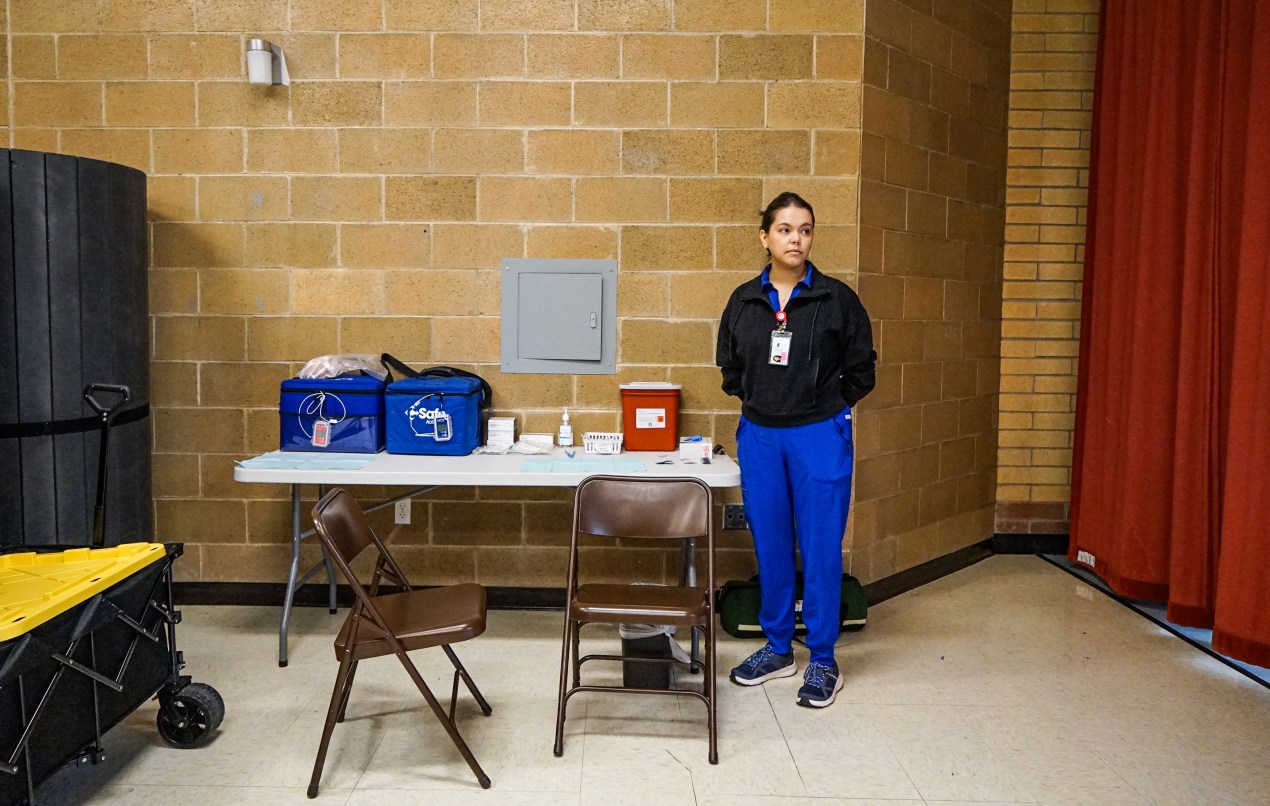
Anna Fajardo, a public health nurse, offers vaccines at a school registration event in Milford, in southwest Utah. A few mothers trickled in to get their children immunized or to find out their child’s vaccination status. (Amy Maxmen/KFF Health News)
As officials tried to do the best they could, the outbreak spread north, hopping from one undervaccinated community to the next. When health officials in Utah County spoke with people who had tested positive, they often had no connection to other known cases. “Pretty quickly, we started to lose the links,” said Michael Leman, the county health department’s nursing director. Contact tracing, the cornerstone of containment, was failing.
Every week, the state health department posted a growing list of locations on its website — a Trader Joe’s, a Mormon temple, an aquarium, preschools — that people had visited while contagious. But many people who tested positive hadn’t been to those places, Leman said. “They could have gotten it at Walmart. They could have gotten it walking through a mall,” he said. “I mean, just anywhere in the public they could have been exposed.”
In February, high school students throughout Utah tested positive after a state wrestling tournament at Utah Valley University in Orem. A dashboard monitoring measles viruses in wastewater lit up with notifications around the state. “Wrestling really feels like our turning point,” said Nicholas Rupp, communications director at the Salt Lake County Health Department.
The new Lindon Utah Temple, belonging to the Church of Jesus Christ of Latter-Day Saints, was one of many locations listed as a potential measles exposure site in April by the Utah Department of Health and Human Services. (Amy Maxmen/KFF Health News)
A Trader Joe’s in Orem, Utah, was also listed as a potential measles exposure site that month. (Amy Maxmen/KFF Health News)
A science building at the University of Utah in Salt Lake City was also among the potential exposure sites listed in April. (Amy Maxmen/KFF Health News)
Many measles cases traced back to a high school wrestling tournament at Utah Valley University in Orem in February. (Amy Maxmen/KFF Health News)
Salt Lake County’s shift from containment to mitigation meant prioritizing high-risk situations and relaxing control everywhere else. When a student has a confirmed case, for example, health officials meet with the school nurse to figure out which kids are most vulnerable. Unvaccinated children in the same classroom as someone infected are asked to stay home for 21 days, but those in other classrooms might not be, said Melanie Crossland, an epidemiologist at the Salt Lake health department. Some schools with high vaccination rates have opted to monitor student temperatures daily instead of requesting quarantines. One school created a separate space for the unvaccinated.
Crossland said such bespoke strategies entail a “huge” amount of effort but have staved off blowback that deflated her during covid.
“We give everything when we’re here,” she said, “but the days of killing ourselves, when legislatively no one is going to give us any help, are done.”
Daycare Dilemma
The outbreak has lasted so long that some children who have recovered from measles have since been hospitalized for what should be mild illnesses from common bugs, said Kerri Smith, a hospital pediatrician in southwest Utah. Measles can erase the immune system’s memory, impairing a body’s ability to fight other viruses. “It’s making children very susceptible to getting sick again,” Smith said.
Her eyes were bloodshot, and she looked drained from a week of long shifts. Since the outbreak began, she’s treated more than a dozen babies and children severely sick from measles.
“They’re usually admitted to the hospital with measles pneumonia, so they’re struggling to breathe, pulling for air below their ribs,” she said. “High fevers, 104 to 105, absolutely miserable, extremely fatigued, really dehydrated with sunken eyes.” Most children fully recover from measles, but a fraction develop permanent hearing loss, a small percentage die, and in rare cases, measles kills a person years after the infection.
No one has died so far in Utah’s outbreak. And barring that tragic outcome, Smith and other doctors said, some parents fail to grasp the gravity of measles, even as their own children have tubes inserted into their small nostrils to deliver oxygen. Despite repeated warnings, doctors said, some unvaccinated family members of patients — who could be contagious — walk around the hospital while visiting their loved one. This means the waiting room, the elevator, the cafeteria, and other places need to be shut down for cleaning, and vulnerable people alerted.
“People don’t realize how easily this spreads,” Smith said.
Morris, the pediatrician working in two counties, recalled a conversation with a nonchalant father who didn’t seem to understand the need for quarantine. “I know this is an inconvenience to you,” she said. “It’s also a huge inconvenience to the parent who has an infant who could be severely impacted by this disease.”
On top of feeling depleted, doctors with young children said they are anxious. Emily Chin, a physician in Salt Lake County, worries she’ll bring measles home to her newborn. One evening, she sat in her garage after caring for a child with a rash. The patient’s measles test was still being processed, so Chin isolated herself in a room for the night, wearing an N95 mask instead of holding her infant.
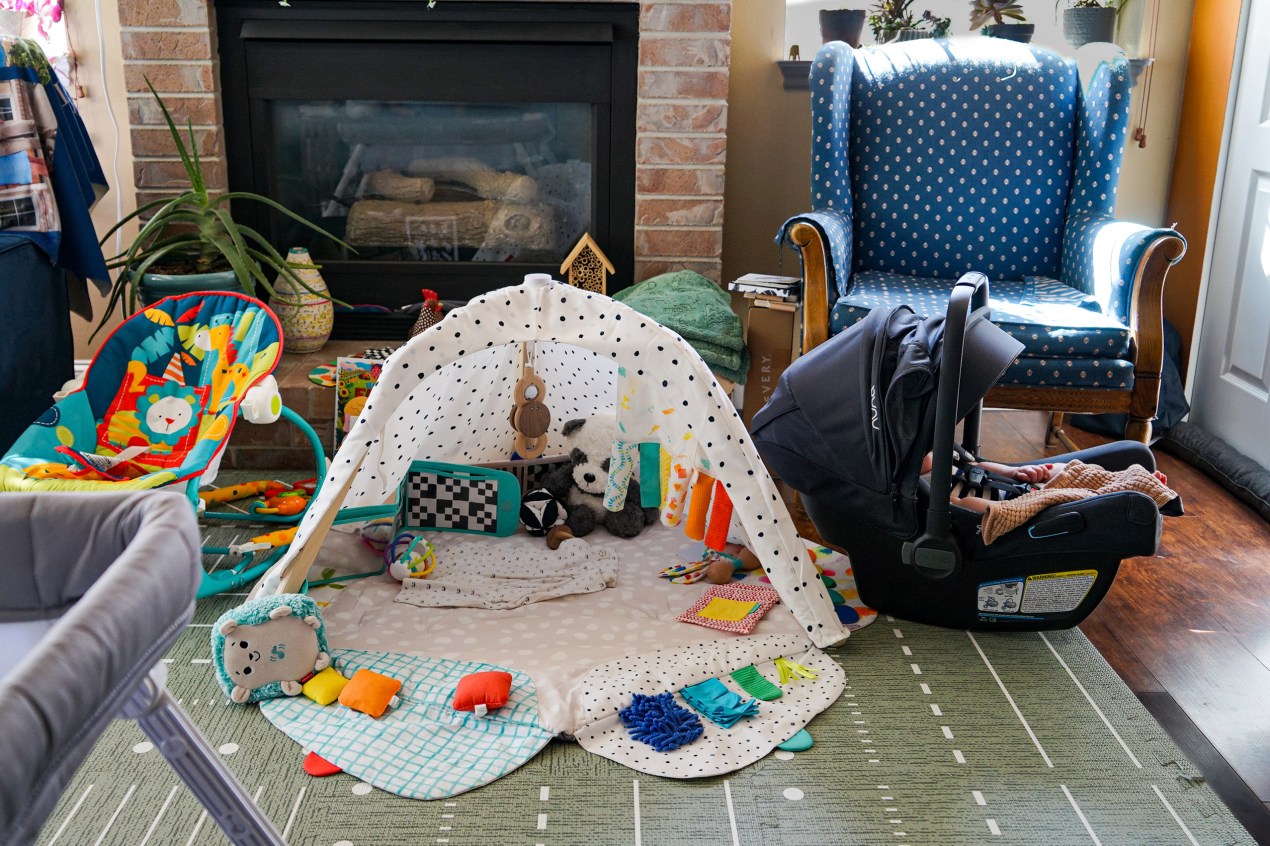
Emily Chin’s 4-month-old, sleeping here at home, is too young to be vaccinated, and Chin, a doctor in Salt Lake County, Utah, worries that she might acquire measles at work and pass it to him. (Amy Maxmen/KFF Health News)
Like many mothers in Utah, Chin plans to give her baby an early dose of the measles vaccine at 6 months old because of the outbreak, in addition to two doses at ages 1 and 4. Several mothers said they avoid travel and public places because they fear their babies could be infected. Some are delaying daycare. Others, like Kandace Hyland, a marketing director in Salt Lake County, don’t have that option.
Hyland was shocked when her daycare told her that it didn’t track the vaccine status of staff, even amid the outbreak. In March, she posted an online petition calling for the state to require daycare staff to be vaccinated against the measles when the virus is spreading. Even if daycare staff file for vaccine exemptions, she said, parents could at least find out what portion of their babies’ caretakers pose a life-threatening risk.
Hyland sent her idea to the state health department. Nolen, the state epidemiologist, said she agreed with the concern, and was “talking with the division of licensing about the issue,” in an email shared with KFF Health News. Hyland also wrote the Division of Licensing and Background Checks. In an email, its director, Shannon Thoman-Black, replied that the division does “not have the legislative authority to implement a mandate.”
“They always talk about parents’ choice,” Hyland said. “But I don’t feel like I have a really good ‘parents’ choice’ right now.”
Measles’ Comeback
The U.S. will almost certainly lose its measles elimination status this year or next, but it could be regained if political leadership backed nationwide campaigns to boost confidence in vaccines, said Demetre Daskalakis, a former director of the Centers for Disease Control and Prevention’s national immunization center and now the chief medical officer at the Callen-Lorde community health center in New York.
“Under Secretary Kennedy’s leadership, that’s unlikely to happen,” he said. “We’re going back to a pre-vaccine era.”
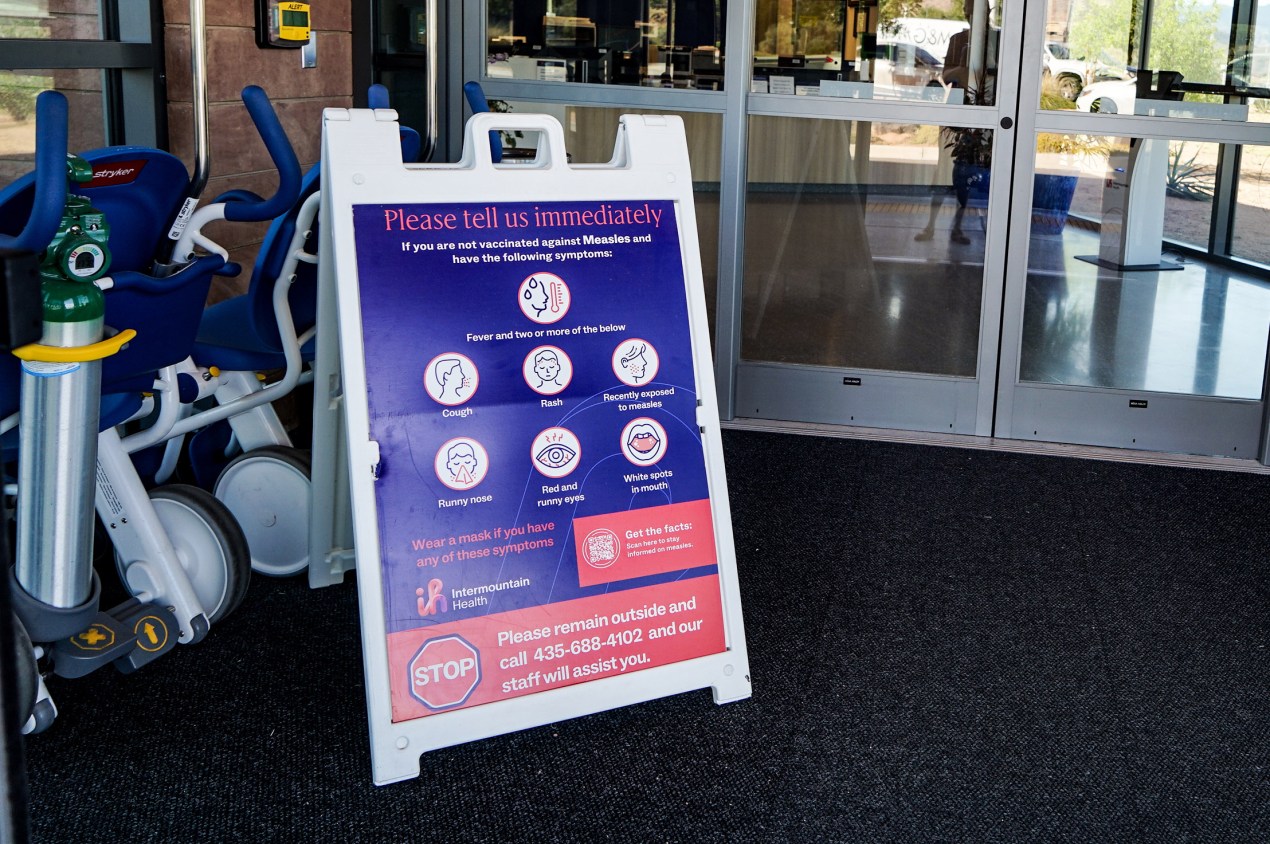
A sign outside a hospital in southwest Utah warns people who haven’t been vaccinated against measles to wait outside if they have a fever and other symptoms, such as coughing or a runny nose. Vulnerable people, including infants too young for vaccination, have been exposed to measles at hospitals and clinics. (Amy Maxmen/KFF Health News)
HHS spokesperson Emily Hilliard defended the secretary and his agency in an email, writing that the CDC has “surged resources” to contain measles outbreaks. “The CDC, HHS principles and the Secretary have been vocal that the MMR vaccine is the best way to protect yourself against measles,” she said.
Kennedy’s words and actions suggest otherwise. He’s said that the measles vaccine leads to “deaths every year,” which is not true. He continuestotout a potential link between autism and vaccines, no matter how many studiesconclude there is none. And he oversaw abrupt changes to the recommended childhood vaccine schedule, a move medical societies called dangerous and not backed by science. A federal judge blocked those changes in March, but Trump recently issued an executive order to reexamine the schedule.
“It’s been confusing for the public,” said Dorothy Adams, executive director of the Salt Lake County Health Department.
In May, Kennedy met with Republican Utah Gov. Spencer Cox, who has said little about the state’s ongoing outbreak. Kennedy praised Utah’s action on Make America Healthy Again priorities, such as banning fluoride in public drinking water and easing restrictions on raw milk sales, according to Salt Lake City’s Deseret News. Cox declined to comment for this article.
Meanwhile, the chronically depleted U.S. public health system has been further weakened by the Trump administration’s cuts and delays to public health grants.
“If you’re in the thick of it and you don’t know if you will be reimbursed, you adjust your response,” said Angela Dunn, a doctor and former Utah state epidemiologist. “This outbreak is a perfect storm of disinformation, trauma from the covid pandemic, and the drop in funding.”
Measles isn’t the only preventable malady making a comeback. As children played nearby in a sun-speckled park in Salt Lake City, Morris talked about a baby in the intensive care unit who was bleeding uncontrollably after a fall. The baby’s parents had refused an injection of vitamin K that helps blood clot in newborns. As they fretted over their infant, Morris said, she felt awful for them and regretted not being able to overcome mistrust in basic, lifesaving interventions. She had the same swirl of emotions when an unvaccinated toddler in her care recently died of whooping cough.
“I was one of the only people in the room with the nurse when the child coded,” she said with tears in her eyes. “You think, ‘I wish this child was vaccinated,’ but it’s hard because I also see how much grief these parents are holding.”
KFF Health News is a national newsroom that produces in-depth journalism about health issues and is one of the core operating programs at KFF—an independent source of health policy research, polling, and journalism. Learn more about KFF.