Jumat, 27 Juni 2025

Kennedy’s Vaccine Advisers Sow Doubts as Scientists Protest US Pivot on Shots

As fired and retired scientists rallied outside in the Atlanta heat, an advisory panel that Robert F. Kennedy Jr. handpicked to replace experts he’d fired earlier met inside the Centers for Disease Control and Prevention’s headquarters to plan a more skeptical vaccine future.

The new members of the Advisory Committee on Immunization Practices began their tenure Wednesday by shifting the posture of the 60-year-old panel from support for vaccine advancement to doubt about the safety and efficacy of well-established and widely administered inoculations.

Their discussions and votes this week paled in significance, however, in comparison with Health and Human Services Secretary Kennedy’s announcement Tuesday that he would withdraw a $1.2 billion U.S. commitment to global immunization.

That decision will kill children in the world’s poorest countries, critics said.

The new ACIP, meanwhile, recommended that newborn Americans get a newly licensed shot to protect them against a respiratory virus. The panel also urged doctors to stop administering influenza vaccine that contains a mercury-based preservative called thimerosal. That decision, in keeping with Kennedy’s disproven claim that thimerosal helped cause an autism epidemic, will have relatively little effect, since only about 4% of flu vaccines currently contain the preservative.

More worrying to vaccine advocates, the committee’s plans to review the government’s childhood vaccine schedule could undermine long-accepted consensus and public confidence, since at least three of the seven committee members have been outspoken opponents of current vaccines. The federal government is legally bound by ACIP’s decisions to provide vaccines it recommends to lower-income children and other groups, and states also follow ACIP’s advice.

Former Harvard University epidemiologist Martin Kulldorff, ACIP’s new chair, set the tone in his opening remarks. “Secretary Kennedy has given this committee a clear mandate to use evidence-based medicine when making vaccination recommendations, and that’s what we will do,” he said.

He added, “There are no wrong questions,” and he announced that a new working group would investigate whether children and adolescents are getting too many vaccines. Another will consider whether to continue ACIP’s 34-year-old recommendation of a birth dose of hepatitis B vaccine, a practice that has dramatically reduced liver disease.

Kulldorff, a covid-19 contrarian and biostatistician who said he was fired by Harvard for refusing a covid vaccination after suffering a severe case of the disease, said the reputations of science and public health have fallen to all-time lows. But scientists and public health officials disagree on who’s to blame.

The biggest cause is “fearmongering and pseudoscience that has overtaken our country,” Caroline Brown, a pediatrician outside Winston-Salem, North Carolina, said during the remote public comment session. She noted that her state’s first measles case of the year was reported this week, panicking many of the families she treats.

Measles was declared eliminated in the United States 25 years ago. It “is back now because of declining rates of vaccination fueled by misinformation that is not only allowed but amplified by some of you sitting on this very committee,” Brown said.

The American Academy of Pediatrics declined to send official liaisons to the meeting and announced on Thursday that it would continue to publish “its own evidence-based recommendations and schedules” for vaccines, blasting Kennedy’s panel.

“What we heard in this meeting was really a false narrative that the current vaccine policies are flawed and that they need fixing,” Sean O’Leary, a physician who chairs the AAP Committee on Infectious Diseases, said in a statement. “That’s completely false. These policies have saved millions of lives, trillions of dollars.”

The CDC’s immunization safety office has conducted studies of the entire vaccine schedule and found no harms, although a 2023 study indicated a possible link between aluminum salts used in some shots and asthma.

Within the CDC conference room, there was a striking contrast between ACIP members and the CDC officials who briefed the panel. While the CDC scientists presented studies showing the safety and value of covid and RSV (respiratory syncytial virus) vaccines, for example, many of the panel members expressed skepticism.

Biochemist Robert Malone and Massachusetts Institute of Technology management professor Retsef Levi — two panelists who have called for banning the mRNA technology used for covid vaccines — were frequently dismissive of the CDC analysis and data.

Malone, Levi, and Vicky Pebsworth — a longtime foe of school vaccination requirements — suggested hidden harms such as “hot lots” of dangerous shots, residual spike protein in the blood from mRNA shots, and inadequate vaccine safety monitoring.

CDC scientists rebutted most of the critiques. But final recommendations on policy will be made by the committee.

Standing along a busy suburban thoroughfare outside the CDC’s headquarters in Atlanta as the meeting rolled on, people critical of the new ACIP were dressed in costumes representing vaccine-preventable diseases — measles, HPV, chickenpox. A small cadre carried balloon letters spelling “R-E-S-T-O-R-E A-C-I-P.” One held a leg splint, commonly used to stabilize the limbs of people with polio, a disease driven to near-extinction by vaccination. Many drivers honked in support as they drove by.

Casey Boudreau, who recently retired from a career working on vaccine-preventable diseases at the CDC, said she was upset by Kennedy’s insistence that the verdict was still out on the safety of some vaccines and by his calls for them to be studied further.

“You’re focusing on reinventing the wheel,” she said. “Do we need to go back and test air bags again? Or do we know they work?”

Tony Fiore, who served as a liaison to ACIP during his some of his time at the CDC before retiring, said he was “greatly concerned” that the committee’s words and actions would “reduce the confidence people have in vaccines and hurt our immunization programs.”

HHS spokesperson Andrew Nixon, who hovered briefly at the edge of rally as people began to gather, dismissed it as “nothing more than a dog and pony show with a lack of serious credibility, evidenced by their Halloween costumes,” in a statement later sent by text message.

At the meeting inside, Kennedy and his agenda loomed in the background, especially after the HHS secretary announced the abandonment of Gavi, an international group that estimates its vaccine programs have saved 18 million lives, mostly in the world’s poorest countries.

The United States has provided 13% of Gavi’s budget, and President Joe Biden had promised an additional $1.2 billion over four years before he left office. Kennedy’s action means that children “will miss lifesaving vaccines” against diseases causing pneumonia, diarrhea, measles, polio, and other diseases, former CDC official Deblina Datta said in an interview.

“There will be deaths,” said Datta, who retired in 2023 after 24 years at the agency. “I am not being hyperbolic. This is a big blow for children worldwide.”

Kennedy said Gavi had not done enough to promote vaccine safety. He also accused the group of complicity in censoring vaccine skeptics like him during the pandemic.

Before Kennedy intervened, the ACIP had been preparing to propose giving children one less shot. The committee was to have voted on reducing vaccinations against HPV, which causes cervical cancer, from two doses to one — because a single shot has proved so effective.

Kennedy has earned hundreds of thousands of dollars in fees from a pending lawsuit against Merck over alleged injuries from one of the HPV vaccines.

While it will have little actual impact, the vote on thimerosal also frustrated vaccine proponents. Public health agencies removed the substance from nearly all childhood vaccines beginning in 1999, out of concern that the accumulation of even tiny amounts of mercury could harm children’s brains and, some believed, cause autism.

Removal of thimerosal from childhood vaccines had no impact on autism rates, however.

But on Thursday, one of the earliest anti-thimerosal activists, nurse Lyn Redwood, presented a paper to ACIP on its dangers. Her arguments were nearly identical to a paper she co-wrote on the subject in 2001.

A summary of the evidence on thimerosal produced by CDC staff was posted online next to Redwood’s slides on Tuesday, but it was removed before the ACIP meeting began. The CDC paper concluded the evidence did not link thimerosal in vaccines to autism or other developmental issues.

According to The Washington Post, Kennedy has appointed Redwood to a position in the CDC’s immunization safety office.

“Removing thimerosal from vaccines didn’t make them safer, just more expensive,” Elias Kass, a naturopathic physician in Seattle, told the committee during a public comment session. “Re-litigation of questions already answered, like the safety of thimerosal, is not advancing radical transparency — it is an insidious attempt to suggest that something was missed or hidden previously.”

Removal of thimerosal from all flu vaccines may have drawbacks.

Two companies — Seqirus and Sanofi — still sell multi-dose flu vaccine vials that contain thimerosal as a preservative. A single vaccination from these 10-dose vials costs 10 to 40 times less than a single-shot prepackaged syringe, according to a CDC price list.

Seqirus will have no trouble replacing its remaining multi-dose vials with single syringes in time for the flu season, spokesperson Melanie Kerin said.

We’d like to speak with current and former personnel from the Department of Health and Human Services or its component agencies who believe the public should understand the impact of what’s happening within the federal health bureaucracy. Please message KFF Health News on Signal at (415) 519-8778 or get in touch here.

KFF Health News is a national newsroom that produces in-depth journalism about health issues and is one of the core operating programs at KFF—an independent source of health policy research, polling, and journalism. Learn more about KFF.

USE OUR CONTENT

This story can be republished for free (details).


from Health Industry Archives - KFF Health News

Kamis, 26 Juni 2025

KFF Health News' 'What the Health?': Live From Aspen — Governors and an HHS Secretary Sound Off

The Host

Julie Rovner KFF Health News @jrovner @julierovner.bsky.social Read Julie's stories. Julie Rovner is chief Washington correspondent and host of KFF Health News’ weekly health policy news podcast, “What the Health?” A noted expert on health policy issues, Julie is the author of the critically praised reference book “Health Care Politics and Policy A to Z,” now in its third edition.

It’s not exactly news that our nation’s health care system is only a “system” in the most generous sense of the word and that no one entity is really in charge of it. Notwithstanding, there are some specific responsibilities that belong to the federal government, others that belong to the states, and still others that are shared between them. And sometimes people and programs fall through the cracks.

Speaking before a live audience on June 23 at Aspen Ideas: Health in Colorado, three former governors — one of whom also served as secretary of the Department of Health and Human Services — discussed what it would take to make the nation’s health care system run more smoothly.

The session, moderated by KFF Health News’ Julie Rovner, featured Democrat Kathleen Sebelius, a former governor of Kansas and HHS secretary under President Barack Obama; Republican Chris Sununu, former governor of New Hampshire; and Democrat Roy Cooper, former governor of North Carolina.

Panelists

Kathleen Sebelius Former HHS secretary, former Kansas governor (D) Chris Sununu Former governor of New Hampshire (R) Roy Cooper Former governor of North Carolina (D)

Among the takeaways from the discussion:

  • States — and the governors who lead them — are major “customers” of the federal health system. For instance, states run research universities with the aid of federal grants from the National Institutes of Health. States also run Medicaid, the joint state-federal program for those with low incomes and disabilities, through which most of the nation’s care for issues such as mental health and substance use disorders is funded. In fact, most federal money sent to states is for Medicaid.
  • Cuts to Medicaid outlined in the House and Senate versions of President Donald Trump’s One Big Beautiful Bill Act would leave a huge hole in state budgets — one that the states, already facing budget constraints, would be unable to fill without making difficult choices. Notably, the bill does not make substantive cuts Medicare, a program that has a significant amount of excess spending and is expected to be insolvent within a decade.
  • Controlling health care costs is a major concern for the future of the nation’s fragmented health care system, as is maintaining the health care workforce. More people without insurance coverage means higher overall costs. Pandemic burnout, immigration raids, and even the cost of college are putting pressure on a dwindling workforce. The federal government could do more to encourage medical professionals to go into primary care and rural health care.

Video of this episode is available here on YouTube.

Credits

Francis Ying Audio producer Emmarie Huetteman Editor

To hear all our podcasts, click here.

And subscribe to KFF Health News’ “What the Health?” on SpotifyApple PodcastsPocket Casts, or wherever you listen to podcasts.

KFF Health News is a national newsroom that produces in-depth journalism about health issues and is one of the core operating programs at KFF—an independent source of health policy research, polling, and journalism. Learn more about KFF.

USE OUR CONTENT

This story can be republished for free (details).


from Health Industry Archives - KFF Health News

Rabu, 25 Juni 2025

What RFK Jr. Isn’t Talking About: How To Make Vaccines Safer

Within an hour of receiving a covid vaccination in November 2020, Utah preschool teacher Brianne Dressen felt pins and needles through her arms and legs. In the medical odyssey that followed, she suffered double vision, chronic nausea, brain fog, and profound weakness. Once a rock climber, she became a couch potato.

Although Dressen’s symptoms were rare in that season of hundreds of millions of covid vaccinations, they were common enough to draw the attention of a National Institutes of Health neuroscientist named Avindra Nath, who examined Dressen and more than 30 other people with a similar syndrome in 2021. He recommended Dressen take steroids and antibodies — treatments that saved her life, she said.

And then, according to emails reviewed by KFF Health News, Nath said he couldn’t help anymore. His clinical study was ending. He directed the patients to seek local help. But, Dressen said, there wasn’t any.

Nath declined to speak to KFF Health News for this article. The FDA searched international vaccine safety databases for small-fiber neuropathy, one of the most common symptoms he mentioned in a write-up of the patients, and found it was less prevalent in vaccinated than in unvaccinated patients, said Peter Marks, who led the FDA division responsible for vaccines until Health and Human Services Secretary Robert F. Kennedy Jr. forced him out in May.

While it’s possible that Nath’s patients suffered covid vaccine injuries, Marks said, their symptoms were so varied it was hard to characterize a possible syndrome.

But for Dressen and others convinced the vaccines injured them, their experiences were symptomatic of a well-intentioned but flawed U.S. system for monitoring the rare ill effects of vaccines. The system isn’t well-funded enough to answer questions that people urgently want answered, and that can feed vaccine hesitancy, safety experts say.

Its shortcomings were on particular display during the mass vaccination campaigns of the pandemic, when even rare, serious side effects could affect thousands of people.

Now some leading vaccine scientists are calling for more resources to research vaccine safety and support people with claims of injury — and asking Kennedy, who has a history as an anti-vaccine activist, to step up.

“Spending money on vaccine safety is not saying vaccines aren’t safe; it’s showing a commitment to continued improvement,” said Y. Tony Yang, a professor of health policy at George Washington University’s Milken Institute School of Public Health.

So far, they’ve been disappointed. While Kennedy gives the public the impression that vaccines are harmful, he hasn’t talked about ways to make them safer. And he’s made the problem worse by cutting programs and dismissing scientists who are most knowledgeable of the problems, according to numerous vaccine experts.

“The reduction in emphasis on the unbiased ascertainment of vaccine safety signals, and redirection toward certain specific issues like autism in vaccines, which we know is not true — that is what’s dangerous,” Marks said.

In March, the Trump administration abruptly canceled a contract with researchers just as they began a massive covid vaccine study aimed at discovering the genetic traits that make certain people vulnerable to vaccine-triggered myocarditis. That condition struck about 1 in 13,000 teenage boys and young men who received two doses of the Pfizer or Moderna mRNA vaccine in 2020 and 2021.

Then, on June 9, Kennedy sacked the entire 17-member Advisory Committee on Immunization Practices, or ACIP, which during the pandemic impaneled a group of experts that reviewed safety data from nearly 700 million covid vaccinations.

The new ACIP contains members who have said most vaccines are dangerous and improperly tested. Sen. Bill Cassidy (R-La.), who chairs the Senate committee with oversight of HHS, said on X on June 23 that the ACIP meeting scheduled for June 25-26 should be delayed until ACIP is staffed with less biased, more knowledgeable members.

HHS officials have suggested that Kennedy intends to throw out the whole vaccine safety system and start over. In a statement to KFF Health News, spokesperson Emily Hilliard accused the Centers for Disease Control and Prevention of “suppressing information about vaccine injuries” and said the Vaccine Adverse Event Reporting System, or VAERS, and the Vaccine Safety Datalink, monitoring systems in place since the early 1990s, were “designed to fail” and “templates of regulatory malpractice.”

She said HHS was “building surveillance systems that will accurately measure vaccine risks as well as benefits.” Asked for details, Hilliard did not respond. The HHS budget proposal for fiscal year 2026 makes no mention of vaccine safety programs.

The current U.S. vaccine safety system began with passage of the 1986 National Childhood Vaccine Injury Act, which aimed at stabilizing the vaccine supply by stopping lawsuits against drug companies. At the time they were getting out of the vaccine business, finding it less risky and more profitable to produce drugs for chronic diseases. The act set up the National Vaccine Injury Compensation Program and VAERS.

CDC vaccine safety officer Robert Chen built on VAERS to create the Vaccine Safety Datalink, which looks for evidence of vaccine harms in electronic health records. In 2001, the CDC set up the Clinical Immunization Safety Assessment project, through which a network of eight U.S. centers study rare vaccine reactions.

But the vaccine safety system’s budget has been stuck at around $20 million most years. That hasn’t been enough to study rare but recurring vaccine injuries in a serious way.

“$20 million to look at all the licensed vaccines in this country is woefully inadequate,” Dan Salmon, director of Johns Hopkins University’s Institute for Vaccine Safety, said at a recent conference. Without a more serious commitment, he said, “our products won’t be as safe as they could be.”

As an HHS vaccine safety official during the Clinton, Bush, and Obama administrations, Salmon helped write two plans that called for expanded safety work, including examinations of whether the vaccine schedule might be contributing to an increase in allergic diseases.

A little-publicized CDC-led 2022 study suggested that the aluminum salts added to make some pediatric vaccines more effective might cumulatively be linked to an increased incidence of asthma. Salmon thinks it merits further research — to refute or confirm the results. The issue “should have been studied decades ago,” he said.

A Failed Compensation Program

Vaccine advocates and skeptics agree that the government program established to compensate people injured by vaccines or other public health measures during emergencies — the Countermeasures Injury Compensation Program — has miserably failed those with covid vaccine-related injuries. As of June 1, the program has compensated only 39 of nearly 14,000 people who have filed covid vaccine injury claims. Only five have gotten awards of more than $10,000.

The program is far less generous and user-friendly than the National Vaccine Injury Compensation Program, funded since 1988 by an excise tax on vaccines. It has paid out about 12,000 awards worth a total of $4.8 billion, mostly to care for vaccine-injured children.

People with covid vaccine injuries, however, are stuck in a kind of limbo, often without clear medical options. It’s unfair and “very bad for public confidence in vaccines,” said Amy Pisani, CEO of Vaccinate Your Family, a nonprofit that promotes vaccination, speaking on a panel with Salmon at the April conference.

Kennedy has condemned the injury compensation system for shielding drug companies from lawsuits, but if he wants to help patients he should move covid vaccines into the program, said Renée Gentry, who runs a law clinic for vaccine injuries at George Washington University Law School.

“The longer you hang these people out to dry, you are creating a perfect storm where nobody’s going to want to get vaccinated,” she said.

A Curtailed Vaccine Injury Investigation

In December 2021, the NIH’s Nath emailed Dressen and the other patients suffering from postvaccine problems that he could no longer help them. He told Science magazine that investigating vaccine side effects was a delicate business when public health leaders were urging everyone to get their shots.

“You have to be very careful. You can make the wrong conclusion,” he said. “The implications are huge.”

Nath published an article in 2023 calling for more investigation of vaccine-related neurological conditions. His lab also released preliminary results from its study of Dressen and the other patients, which pointed to helpful treatments. But the paper has not been published in a peer-reviewed journal.

And none of the federal agencies recognized that her condition might be vaccine-related, said Dressen, who received her shot in an AstraZeneca clinical trial. (FDA officials were concerned about the vaccine’s side effect profile, and it was never distributed in the United States.)

Dressen said Nath’s withdrawal left her distraught.

“They reassure everyone there’s a safety net, but every one of those things is a complete failure,” she said. “I didn’t speak out because of my injury. The reason I spoke out is because of what happened after my injury.”

“People are suffering, and we don’t yet understand why or how to help them,” said Harlan Krumholz, a cardiologist who is part of a research project at Yale University led by immunobiologist Akiko Iwasaki that includes hundreds of patients with postvaccine issues. “Worse, many of them have felt ignored or dismissed by the very institutions meant to help and support them.”

The NIH appears not to have funded studies of postvaccine syndrome, whose symptoms mimic those of long covid. Yet genetic studies could help “to determine who might be more susceptible to this condition,” Iwasaki said in an email.

Such research appears ideal for the Clinical Immunization Safety Assessment, established to examine rare vaccine reactions. But the network has published nothing on covid vaccines, nor are any trials related to the issue listed on government websites.

German researchers have studied postvaccine syndrome in more depth. Germany’s Paul-Ehrlich-Institut, a sort of FDA for vaccines, reported in December that it had reviewed 919 cases of postvaccine syndrome that were similar to long covid — a rate of about 1 in 100,000 vaccinations. It said causality was hard to establish because of the diverse symptoms reported.

Can Vaccine Safety Move Out of HHS?

In 1999, Chen, the CDC scientist, published an article suggesting that to speed studies and boost public confidence, vaccine safety should be moved to an independent agency, perhaps modeled on the National Transportation Safety Board, that could subpoena records from industry or other government agencies for its crash investigations.

Although HHS did not respond to a query about the idea, vaccine litigant Aaron Siri, who has been a personal attorney to Kennedy, told KFF Health News that Kennedy supported it.

In the meantime, some vaccinologists hope they can persuade Kennedy to spend more money on good vaccine safety research.

While it is “very painful to watch” what Kennedy is doing to HHS vaccine policy, “it would behoove us to find common ground,” Salmon said at the conference. That doesn’t mean “funding terrible studies to confirm hypotheses that some people believe,” he added.

Though that is what many see Kennedy doing. One of his first moves as secretary was to hire David Geier, whose previous publications are considered junk science by many in the field, to conduct a review of vaccine links to autism. Studies around the world have thoroughly debunked such a connection.

Building on an Existing System

When HHS’ Vaccine Safety Datalink was set up in the early 1990s, it was the envy of the world. There are now also good systems in Denmark, England, Israel, and Australia, but the U.S. system has worked pretty well, said Steve Black, who co-directed the Kaiser Permanente Vaccine Study Center from 1985 until 2007.

The Vaccine Safety Datalink was largely responsible for the 1999 removal of a rotavirus vaccine that triggered rare intestinal disorders in babies. And its discovery of a rare but deadly side effect helped keep the AstraZeneca covid vaccine off the U.S. market and led to the removal of the Johnson & Johnson vaccine, Black said. It also helped pinpoint myocarditis soon after young men began getting mRNA shots in 2021.

Since 2019, Black has co-directed an ambitious, 30-country consortium called the Global Vaccine Data Network, which enables vaccine safety analyses across massive, diverse populations around the world.

The group was just beginning its study of genetic predispositions to myocarditis when the Trump administration withdrew a $2 million CDC payment, halting the work.

An email from the Department of Government Efficiency, or DOGE, “asked a bunch of irrelevant questions like, Had we ever been funded by China? Did we have collaborators in Europe?” It ordered the network to cease and desist with no due process or means of appeal, Black said.

Research funded by the grant had progressed to the point of finding seven genetic variants known to be related to cardiac inflammation in people who got myocarditis postvaccination, said Bruce Carleton, the lead investigator, at the University of British Columbia. Work remains, but the data suggests a $6 test could clear vulnerable patients before they are vaccinated, Carleton said.

“Millions got mRNA vaccines. Very few got myocarditis,” Black said. “The public would like to know, ‘Am I at risk?’ Genetics can answer that.”

The CDC has been an honest broker of vaccine safety information, Black added, but if taking the issue out of HHS would improve public confidence, he’s for it.

Vaccines need to be safer, Dressen said, but the idea of banning them doesn’t sit well with her.

“There’s the crowd that wants mRNA vaccines to be pulled off the market, but that’s not going to fix the problem. Vaccines are not going to go away,” she said.

As of June 5, a patient group she leads had provided $1.2 million to 162 people needing medical care for injuries they attributed to vaccination.

Meanwhile, the federal countermeasures program, which doles out covid vaccine injury awards through a trust, has committed $2.6 million for one patient and $370,376 for another. As of June 1, it had granted an additional 37 claimants a grand total of $198,809.92.

KFF Health News is a national newsroom that produces in-depth journalism about health issues and is one of the core operating programs at KFF—an independent source of health policy research, polling, and journalism. Learn more about KFF.

USE OUR CONTENT

This story can be republished for free (details).


from Health Industry Archives - KFF Health News

Selasa, 24 Juni 2025

5 Takeaways From Health Insurers’ New Pledge To Improve Prior Authorization

Nearly seven months after the fatal shooting of an insurance CEO in New York drew widespread attention to health insurers’ practice of denying or delaying doctor-ordered care, the largest U.S. insurers agreed Monday to streamline their often cumbersome preapproval system.

Dozens of insurance companies, including Cigna, Aetna, Humana, and UnitedHealthcare, agreed to several measures, which include making fewer medical procedures subject to prior authorization and speeding up the review process. Insurers also pledged to use clear language when communicating with patients and promised that medical professionals would review coverage denials.

While Trump administration officials applauded the insurance industry for its willingness to change, they acknowledged limitations of the agreement.

“The pledge is not a mandate,” Mehmet Oz, administrator of the Centers for Medicare & Medicaid Services, said during a news conference. “This is an opportunity for the industry to show itself.”

Oz said he wants insurers to eliminate preapprovals for knee arthroscopy, a common, minimally invasive procedure to diagnose and treat knee problems. Chris Klomp, director of the Center for Medicare at CMS, recommended prior authorization be eliminated for vaginal deliveries, colonoscopies, and cataract surgeries, among other procedures. Health insurers said the changes would benefit most Americans, including those with commercial or private coverage, Medicare Advantage, and Medicaid managed care.

The insurers have also agreed that patients who switch insurance plans may continue receiving treatment or other health care services for 90 days without facing immediate prior authorization requirements imposed by their new insurer.

But health policy analysts say prior authorization — a system that forces some people to delay care or abandon treatment — may continue to pose serious health consequences for affected patients. That said, many people may not notice a difference, even if insurers follow through on their new commitments.

“So much of the prior authorization process is behind the black box,” said Kaye Pestaina, director of the Program on Patient and Consumer Protections at KFF, a health information nonprofit that includes KFF Health News.

Often, she said, patients aren’t even aware that they’re subject to prior authorization requirements until they face a denial.

“I’m not sure how this changes that,” Pestaina said.

The pledge from insurers follows the killing of UnitedHealthcare CEO Brian Thompson, who was shot in midtown Manhattan in early December on the way to an investor meeting, forcing the issue of prior authorization to the forefront.

Oz acknowledged “violence in the streets” prompted Monday’s announcement. Klomp told KFF Health News that insurers were reacting to the shooting because the problem has “reached a fever pitch.” Health insurance CEOs now move with security details wherever they go, Klomp said.

“There’s no question that health insurers have a reputation problem,” said Robert Hartwig, an insurance expert and a clinical associate professor at the University of South Carolina.

The pledge shows that insurers are hoping to stave off “more draconian” legislation or regulation in the future, Hartwig said.

But government interventions to improve prior authorization will be used “if we’re forced to use them,” Oz said during the news conference.

“The administration has made it clear we’re not going to tolerate it anymore,” he said. “So either you fix it or we’re going to fix it.”

Here are the key takeaways for consumers:

1. Prior authorization isn’t going anywhere.

Health insurers will still be allowed to deny doctor-recommended care, which is arguably the biggest criticism that patients and providers level against insurance companies. And it isn’t clear how the new commitments will protect the sickest patients, such as those diagnosed with cancer, who need the most expensive treatment.

2. Reform efforts aren’t new.

Most states have already passed at least one law imposing requirements on insurers, often intended to reduce the time patients spend waiting for answers from their insurance company and to require transparency from insurers about which prescriptions and procedures require preapproval. Some states have also enacted “gold card” programs for doctors that allow physicians with a robust record of prior authorization approvals to bypass the requirements.

Nationally, rules proposed by the first Trump administration and finalized by the Biden administration are already set to take effect next year. They will require insurers to respond to requests within seven days or 72 hours, depending on their urgency, and to process prior authorization requests electronically, instead of by phone or fax, among other changes. Those rules apply only to certain categories of insurance, including Medicare Advantage and Medicaid.

Beyond that, some insurance companies committed to improvement long before Monday’s announcement. Earlier this year, UnitedHealthcare pledged to reduce prior authorization volume by 10%. Cigna announced its own set of improvements in February.

3. Insurance companies are already supposed to be doing some of these things.

For example, the Affordable Care Act already requires insurers to communicate with patients in plain language about health plan benefits and coverage.

But denial letters remain confusing because companies tend to use jargon. For instance, AHIP, the health insurance industry trade group, used the term “non-approved requests” in Monday’s announcement.

Insurers also pledged that medical professionals would continue to review prior authorization denials. AHIP claims this is “a standard already in place.” But recent lawsuits allege otherwise, accusing companies of denying claims in a matter of seconds.

4. Health insurers will increasingly rely on artificial intelligence.

Health insurers issue millions of denials every year, though most prior authorization requests are quickly, sometimes even instantly, approved.

The use of AI in making prior authorization decisions isn’t new — and it will probably continue to ramp up, with insurers pledging Monday to issue 80% of prior authorization decisions “in real-time” by 2027.

“Artificial intelligence should help this tremendously,” Rep. Gregory Murphy (R-N.C.), a physician, said during the news conference.

“But remember, artificial intelligence is only as good as what you put into it,” he added.

Results from a survey published by the American Medical Association in February indicated 61% of physicians are concerned that the use of AI by insurance companies is already increasing denials.

5. Key details remain up in the air.

Oz said CMS will post a full list of participating insurers this summer, while other details will become public by January.

He said insurers have agreed to post data about their use of prior authorization on a public dashboard, but it isn’t clear when that platform will be unveiled. The same holds true for “performance targets” that Oz spoke of during the news conference. He did not name specific targets, indicate how they will be made public, or specify how the government would enforce them.

While the AMA, which represents doctors, applauded the announcement, “patients and physicians will need specifics demonstrating that the latest insurer pledge will yield substantive actions,” the association’s president, Bobby Mukkamala, said in a statement. He noted that health insurers made “past promises” to improve prior authorization in 2018.

Meanwhile, it also remains unclear what services insurers will ultimately agree to release from prior authorization requirements.

Patient advocates are in the process of identifying “low-value codes,” Oz said, that should not require preapproval, but it is unknown when those codes will be made public or when insurers will agree to release them from prior authorization rules.

Do you have an experience with prior authorization you’d like to share? Click here to tell your story.

KFF Health News is a national newsroom that produces in-depth journalism about health issues and is one of the core operating programs at KFF—an independent source of health policy research, polling, and journalism. Learn more about KFF.

USE OUR CONTENT

This story can be republished for free (details).


from Health Industry Archives - KFF Health News

‘We Need To Keep Fighting’: HIV Activists Organize To Save Lives as Trump Guts Funding

GREENVILLE, Miss. — Cedric Sturdevant woke up with “a bit of depression” but made it to church, as he does every Sunday. In a few days, he would drive from Mississippi to Washington, D.C., to join HIV advocates at an April rally against the Trump administration’s actions.

It had clawed back more than $11 billion in federal public health grants to states and abruptly terminated millions of dollars in funds for HIV work in the United States. Testing and outreach for HIV faltered in the South, a region that accounts for more than half of all HIV diagnoses.

Dangerous changes loomed: To compensate for tax cuts for the wealthy, Trump’s “big, beautiful” bill and budget proposal for fiscal year 2026 threaten to curtail Medicaid, which provides health coverage for people with low incomes and disabilities. About 40% of adults with HIV rely on it for their lifesaving treatments.

Further, the budget proposes to eliminate all HIV prevention programs at the Centers for Disease Control and Prevention. This alone could lead to an additional 14,600 HIV-related deaths within the next five years, according to one analysis.

Trump’s budget proposal also would cancel a major grant that provides housing assistance for people with HIV. And it would end a strategic initiative to expand HIV services in minority communities, and another to support the mental health of people of color with HIV or at risk of infection.

“President Trump is committed to eliminating radical gender and racial ideologies that poison the minds of Americans,” a White House addendum to the budget says. Letters terminating HIV grants used similar language, targeting “diversity,” “equity,” and “gender minorities,” words that focus resources where they are needed most. Black and Latino people account for about 70% of new HIV infections in the U.S.

The cuts affect Sturdevant personally. He is a gay, Black man living with HIV and the co-founder of a grassroots group that combats health disparities in the Mississippi Delta, one of the poorest regions of the country.

That morning at church, a close friend, pastor Jerry Shelton of Anointed Oasis of Love Ministry, asked Sturdevant to help him deliver a sermon about resisting the urge to give up when life is hard. “The storm may come, but I shall not be moved!” Shelton preached, directing the congregation to approach adversity with confidence in themselves and in God. “Walk boldly!” he shouted.

After the service, Sturdevant resolved to bring the same energy to Washington. He’d tell his colleagues that they are survivors, he said. He’d tell them, “Let’s get together and make a plan.”

In the past few months, HIV advocates have begun to organize and strategize ways to limit the damage as federal funds are slashed and inflammatory rhetoric rises.

“It is a very scary time to be Black, queer, and living with HIV,” said Marnina Miller, co-executive director of the Positive Women’s Network, a nationwide group for women living with HIV. “But I am grateful that I am part of a community that will not bow down.”

“People are not giving up,” said June Gipson, the CEO of a health care nonprofit, My Brother’s Keeper, in Mississippi. Then she referenced the 1980s cartoon where heroes combine forces to create a super robot to defend the universe:

“We’ve got to form Voltron.”

The Weight of Stigma

Sturdevant often reminds his colleagues of all the HIV movement has overcome. In the 1980s, the government refused to acknowledge HIV as gay men died young. Once powerful treatments were available in the 1990s and early 2000s, the public health establishment largely neglected Black people with HIV, especially in the South. In that period, the demographics of the epidemic shifted away from white, upper- and middle-class gay populations in liberal states. Half of new diagnoses today are in the South and a third are among people with low incomes.

When Sturdevant first tested positive for HIV in 2005, he didn’t seek treatment. He kept his diagnosis hidden from friends and family because he knew how people talked about HIV. They considered it a death sentence, a punishment for irresponsible behavior, or a disease that could infect them through a touch or a shared toilet seat — which it cannot.

“I thought my family was going to disown me,” he said.

A year later, his weight plummeted because he couldn’t hold down food or water. Gaunt and feverish, he went to the hospital and learned he had AIDS. His mother slept at his hospital bedside for two weeks: “She said, ‘God got you.’”

Once he regained his health, Sturdevant resolved to care for others in his position. Scientists had developed powerful HIV drugs that, if taken daily, transform it from a death sentence into a manageable chronic disease in which a person’s virus levels are so suppressed that they cannot spread HIV to others. And policymakers ensured that almost everyone in the U.S. with HIV could get treated regardless of their ability to pay, largely because of Medicaid and the Ryan White HIV/AIDS Program.

But HIV experts had failed to overcome a key problem: Roughly a third of people living with HIV in the U.S. don’t get treated or don’t take the drugs regularly enough to be virally suppressed. Viral suppression rates are better in many African countries than in America.

To seek treatment and stick with it, Sturdevant understood, people had to have basic needs like food and housing met and, as importantly, a sense of belonging and empowerment. At his first job at an HIV organization in Jackson, Mississippi, Sturdevant regularly checked in with clients who didn’t have family members to support them. He hosted gatherings at his apartment and even offered it up as a place to stay. He has taken on the role of dad or uncle to many. “We called ourselves the family of love,” he said.

He saw how care bolstered lives, but the federal government needed data to drive its approach to HIV.

In 2012, the CDC expanded its in-depth surveys to learn more about the lives of people at risk of HIV and of those with HIV who weren’t virally suppressed. The surveys revealed what Sturdevant knew: A disproportionate number of them grappled with unstable housing, food insecurity, depression, and anxiety. Many participants agreed to prompts like, “Having HIV makes me feel that I’m a bad person,” or “Most people think that a person with HIV is disgusting,” or “Most people with HIV are rejected.”

The data showed policymakers that to curb the epidemic, they needed to address underlying problems that people with HIV faced. Federal funds began to flow to grassroots groups embedded in marginalized communities.

Public health researchers folded Black churches into the effort, recognizing them as hubs of volunteerism and as leaders of social movements. Although churches in the U.S. had historically fueled stigma against sexually transmitted diseases, Amy Nunn, a public health researcher at Brown University, said every pastor she talked with was eager to help. It paid off. In Kansas City, for example, researchers found that congregants who went to Black churches involved in HIV education and outreach were more than twice as likely to be tested.

Community-based interventions worked: New HIV infections dropped by 12% from 2018 to 2022.

Now the grassroots groups that have been so effective are in jeopardy and the in-depth surveys have halted as the Trump administration cuts funds and lays off CDC staff. Some health departments have issued stop-work orders to community-based groups that test people for HIV and connect them to treatment because federal HIV grants are unusually delayed. And as the Department of Health and Human Services continues to cancel HIV grants, the directors of grassroots groups anticipate more cuts.

“A lot of them are new and don’t have the resources to survive a year without funding,” said Masen Davis, executive director of Funders Concerned About AIDS.

One such group is Sturdevant’s.

‘Trust the Process’?

In 2017, Sturdevant returned home to the Mississippi Delta to launch a nonprofit, Community Health PIER, in one of the poorest and most medically underserved parts of the country. The average life expectancy in the Delta is 68, a decade shorter than the national average. The disenfranchisement of its majority-Black population stems from the region’s history, in which policies concentrated wealth and power among the minority-white population during the era of cotton sharecropping, Jim Crow laws and segregation, and, recently, due to gerrymandering.

Sturdevant set up shop in Greenville, near a Black church that served as a headquarters for civil rights activists in the 1960s. In a small office, his team organizes health events, tests people for HIV, and connects those who test positive with treatment and housing assistance, funded through federal programs like Ryan White.

“Whites have been getting Ryan White and other programs for years and living healthy,” said Ashley Richardson, administrative assistant of Sturdevant’s group. “Around here, Black people are just now getting to the point where we know there are resources to help.”

Lately the team fields calls from people with HIV who are terrified they will lose their lifesaving drugs and housing if government programs no longer help with the cost.

Sturdevant worries about keeping his staff employed and his community safe. On the drive home from the April event in Washington, he drearily recounted conversations with Republicans in Congress: “They basically all said trust the process.”

The heads of national HIV organizations have stepped up their advocacy, asking Congress to oppose cuts in President Donald Trump’s budget request, said Gregorio Millett, director of public policy at the Foundation for AIDS Research, a nonprofit known as amfAR.

Emily Hilliard, spokesperson for the Department of Health and Human Services, responded to queries from KFF Health News by writing, “Critical HIV/AIDS programs will continue under the Administration for a Healthy America.” Yet the administration’s proposed budget for HIV prevention represents a 78% reduction compared with fiscal year 2025, according to a KFF analysis.

HHS Secretary Robert F. Kennedy Jr. has fostered skepticism  about scientific facts concerning HIV, without citing evidence. “Any questioning of the orthodoxy that HIV is the sole cause of AIDS remains an unforgivable-even dangerous-heresy among our reigning medical cartel,” he wrote in a 2021 book.

Not Bowing to Barriers

Researchers and HIV advocates are hashing out strategies to fill in the vacuum in HIV care that the government is poised to leave. For decades, it has driven priorities, coordinated a constellation of HIV groups, and tracked the epidemic. Leisha McKinley-Beach, CEO of a training institute, Black Public Health Academy, in Atlanta, said people must remember that wasn’t always the case.

“This massive industry we have today was created by committed individuals at the grassroots level, who were going to help people live with HIV or die with dignity, by any means necessary,” she said.

One idea is to have larger, established HIV organizations partner with nascent groups in underserved regions. The bigger ones stand a better chance of garnering significant private donations. And by taking on the fiscal management of grants, large groups could enable small ones to devote time to service rather than fundraising, McKinley-Beach said.

Another strategy, said Kathy Garner, executive director of Mississippi’s AIDS Services Coalition, is to fill gaps by coordinating with churches and nonprofits dedicated to food assistance, housing, or mental health.

“One of the solutions is going to be civil society stepping up,” Garner said. “That’s an old term for people taking care of each other, outside of the government.”

“We’re going to need to ramp up our services in all kinds of ways, and health and HIV will be a part of that,” said Bishop Ronnie Crudup of New Horizon Church International in Jackson, and a member of Mississippi Faith in Action, a coalition of African American churches involved in HIV.

“I have real concerns with what the Trump administration is doing, and how it will play out for the health of people in a poor state,” he said.

National groups, such as AIDS United, have been speaking with corporate funders and philanthropies about building a pooled fund to help sustain HIV organizations across the U.S.

Philanthropy for HIV has never come close to matching federal dollars, however. Non-governmental funders put $284 million toward HIV in the U.S. in 2023, compared with about $16 billion in annual federal funds for HIV in recent years.

“The truth is there is no way for philanthropy to make up for the cuts from the federal government,” Davis said. “I suspect we will see new infections rise within 18 months, which is heartbreaking.”

Sturdevant focuses on survival, not forecasts. “This isn’t going to be easy,” he said, “but we need to keep fighting for those who don’t have the fight in them.”

KFF Health News is a national newsroom that produces in-depth journalism about health issues and is one of the core operating programs at KFF—an independent source of health policy research, polling, and journalism. Learn more about KFF.

USE OUR CONTENT

This story can be republished for free (details).


from Health Industry Archives - KFF Health News

Senin, 23 Juni 2025

Muchas personas mayores aceptan las vacunas con entusiasmo. La investigación les da la razón

Kim Beckham, agente de seguros en Victoria, Texas, había visto a sus amigos sufrir tanto por la culebrilla (shingles) que quería recibir la primera vacuna aprobada contra esta infección tan pronto como estuviera disponible, incluso si tenía que pagarla de su bolsillo.

Su médico y varias farmacias le dijeron que no podían administrarle la vacuna porque no tenía la edad recomendada en ese momento, que era de 60 años. Así que, en 2016, celebró su cumpleaños 60 en su CVS local.

“Estuve allí cuando abrieron”, recordó Beckham. Después de recibir su inyección de Zostavax, dijo: “Me sentí muy aliviada”. Desde entonces, ha recibido la vacuna contra la culebrilla, más reciente y eficaz, además de otras: contra la neumonía, el virus respiratorio sincitial (VRS), las dosis anuales contra la gripe y todas las recomendadas contra covid-19.

Algunas personas mayores están muy contentas de vacunarse.

A Robin Wolaner, de 71 años, editora jubilada de Sausalito, California, la conocen por ser insistente con sus amigos que tardan en recibir las vacunas recomendadas, les manda estudios médicos relevantes. “Los sermoneo un poco”, admitió.

Deana Hendrickson, de 66, quien cuida a diario a tres nietos pequeños en Los Ángeles, pidió una dosis adicional de la triple vírica (SPR), aunque fue vacunada contra el sarampión, las paperas y la rubéola de niña, lo hizo por si su inmunidad al sarampión había disminuido.

Para los adultos mayores que expresan mayor confianza en la seguridad de las vacunas que los grupos más jóvenes, los últimos meses han traído consigo investigaciones muy positivas.

Estudios recientes han descubierto importantes beneficios de una nueva vacuna, versiones mejoradas, y otra que podría ofrecer una ventaja importante que nadie previó.

Los nuevos estudios llegan en un momento político tenso. El secretario de salud de la nación, Robert F. Kennedy Jr., ha menospreciado durante mucho tiempo ciertas vacunas, calificándolas de inseguras y afirmando que los funcionarios de gobierno que las regulan son corruptos y están comprometidos.

El 9 de junio, Kennedy despidió a un panel de asesores científicos de los Centros para el Control y Prevención de Enfermedades (CDC) y luego los reemplazó por algunos que se han mostrado escépticos respecto a las inmunizaciones. Sin embargo, hasta el momento, Kennedy no ha intentado restringir el acceso a las vacunas para los estadounidenses mayores.

La evidencia de que las vacunas son beneficiosas sigue siendo abrumadora.

La frase “Las vacunas ya no son solo para niños” se ha convertido en una de las favoritas de William Schaffner, especialista en enfermedades infecciosas del Centro Médico de la Universidad de Vanderbilt.

“La población mayor de 65 años, que a menudo sufre el peor impacto de los virus respiratorios y otros, ahora se beneficia de vacunas que pueden prevenir gran parte de esas enfermedades graves”, afirmó Schaffner.

Tomemos como ejemplo la gripe, que anualmente envía de 140.000 a 710.000 personas a hospitales, la mayoría de ellas seniors, y es mortal para el 10% de los adultos mayores hospitalizados.

Por unos 15 años, los CDC han aprobado varias vacunas antigripales mejoradas para personas de 65 años o más. Más eficaces que la formulación estándar, estas vacunas contienen niveles más altos del antígeno que genera protección contra el virus o incorporan un adyuvante que crea una respuesta inmunitaria más fuerte. También son vacunas recombinantes, desarrolladas mediante un método diferente, con niveles más altos de antígeno.

En un metaanálisis publicado en el Journal of the American Geriatrics Society, “todas las vacunas mejoradas fueron superiores a la dosis estándar para prevenir hospitalizaciones”, expresó Rebecca Morgan, metodóloga de investigación en salud de la Universidad Case Western Reserve y autora del estudio.

En comparación con la vacuna antigripal estándar, las vacunas mejoradas redujeron el riesgo de internaciones por gripe en adultos mayores entre un 11% y un 18%. Los CDC recomiendan a los adultos mayores de 65 recibir las vacunas mejoradas, como muchos ya lo hacen.

Más buenas noticias: las vacunas para prevenir el virus respiratorio sincitial en personas mayores de 60 están dando buenos resultados.

El VRS es la causa más común de hospitalización en bebés y también representa riesgos significativos para los adultos mayores. “Temporada tras temporad, produce brotes de enfermedades respiratorias graves que rivalizan con la influenza”, afirmó Schaffner.

Dado que la Administración de Drogas y Alimentos de Estados Unidos (FDA) aprobó por primera vez una vacuna contra el VRS en 2023, la temporada 2023-24 brindó “la primera oportunidad de observarla en un contexto real”, explicó Pauline Terebuh, epidemióloga de la Facultad de Medicina Case Western Reserve y autora de un estudio reciente publicado en la revista JAMA Network Open.

Al analizar los historiales médicos electrónicos de casi 800.000 pacientes, los investigadores descubrieron que las vacunas tenían una eficacia del 75% contra la infección aguda, es decir, enfermedades lo suficientemente graves como que el pacientes pida una cita con un proveedor de salud.

Las vacunas tuvieron una eficacia del 75 % en la prevención de visitas a salas de emergencia, y del 75% en hospitalizaciones, en personas de 60 a 74 años, y mayores.

A pesar de que obtienen un nivel de protección ligeramente menor de la vacuna, los pacientes inmunodeprimidos también se beneficiarán al vacunarse, afirmó Terebuh.

En cuanto a los efectos adversos, el estudio reveló un riesgo muy bajo de síndrome de Guillain-Barré, una afección poco común que causa debilidad muscular y que suele aparecer tras una infección, en aproximadamente 11 casos por cada millón de dosis de vacuna. Esto, enfatizó, “no debería disuadir a la gente”.

Ahora, los CDC recomiendan la vacunación contra el VRS para las personas mayores de 75 años, y para las de 60 a 74 años si tienen un mayor riesgo de enfermedad grave (a causa de, por ejemplo, una enfermedad cardíaca).

A medida que se disponga de datos de la temporada 2024-25, los investigadores esperan determinar si la vacuna seguirá siendo de una sola dosis o si la inmunidad requerirá la vacunación cada determinado tiempo.

Las personas mayores de 65 años expresan la mayor confianza en la seguridad de las vacunas que cualquier otro grupo de adultos, según una encuesta de KFF realizada en abril. Más del 80% afirmó tener “mucha” o “algo” confianza en las vacunas contra el sarampión, la rubéola, la neumonía y la gripe.

Aunque la vacuna contra covid obtuvo un apoyo más bajo entre los adultos, más de dos tercios de las personas mayores expresaron confianza en su seguridad.

Incluso los escépticos podrían entusiasmarse con un posible beneficio de la vacuna contra la culebrilla: esta primavera, investigadores de la Universidad de Stanford informaron que, en siete años, la vacunación contra la culebrilla redujo el riesgo de demencia en un 20%, un hallazgo que estuvo en los titulares noticiosos.

Los sesgos a menudo socavan los estudios observacionales que comparan grupos vacunados con no vacunados. “Las personas más sanas y con mayor motivación por la salud son las que se vacunan”, afirmó Pascal Geldsetzer, epidemiólogo de la Knight Initiative for Brain Resilience de Stanford, y autor principal del estudio.

“Es difícil saber si se trata de una relación de causa y efecto o si, de todos modos, tienen menos probabilidades de desarrollar demencia”, agregó.

Así que el equipo de Stanford aprovechó un “experimento natural” cuando se introdujo la primera vacuna contra el herpes zóster, Zostavax, en Gales. Las autoridades sanitarias establecieron un límite de edad estricto: las personas que cumplieran 80 años el 1 de septiembre de 2013 o antes no eran elegibles para la vacunación, pero quienes eran incluso un poco más jóvenes sí lo eran.

En la muestra de casi 300.000 adultos cuyos cumpleaños coincidían con esa fecha, casi la mitad del grupo elegible recibió la vacuna, pero prácticamente nadie del grupo de más edad lo hizo.

“Al igual que en un ensayo aleatorio, estos grupos de comparación deberían ser similares en todos los aspectos”, explicó Geldsetzer. Una reducción sustancial en los diagnósticos de demencia en el grupo elegible para la vacuna, con un efecto protector mucho mayor en las mujeres, constituye, por lo tanto, una “evidencia más contundente y convincente”, afirmó.

El equipo también observó una reducción en las tasas de demencia tras la introducción de las vacunas contra el herpes zóster en Australia y otros países. “Seguimos observando esto en un conjunto de datos tras otro”, concluyó Geldsetzer.

En Estados Unidos, donde una vacuna más potente, Shingrix, se lanzó en 2017 y sustituyó a Zostavax, investigadores de la Universidad de Oxford observaron un efecto aún más fuerte.

Al comparar a casi 104.000 estadounidenses mayores que recibieron una primera dosis de la nueva vacuna (la inmunización completa requiere de dos) con un grupo que había recibido la formulación anterior, observaron un retraso en la aparición de demencia en el grupo de Shingrix.

Aún no se ha explicado cómo una vacuna contra el herpes zóster podría reducir la demencia. Los científicos han sugerido que los propios virus pueden contribuir a la demencia, por lo que suprimirlos podría proteger el cerebro. Quizás la vacuna reactive el sistema inmunitario en general o afecte la inflamación.

“No creo que nadie lo sepa”, dijo Paul Harrison, psiquiatra de la Universidad de Oxford y autor principal del estudio. Pero, “ahora estoy convencido de que hay algo real aquí”, dijo.

Shingrix, ahora recomendada para adultos mayores de 50 años, tiene una eficacia del 90% en la prevención del herpes zóster y el dolor nervioso persistente que puede generar. Sin embargo, en 2021, solo el 41% de los adultos de 60 años o más había recibido una dosis de alguna de las vacunas contra el herpes zóster.

La conexión con la demencia requerirá más investigación, y Geldsetzer está intentando recaudar fondos de filántropos para un ensayo clínico.

Y “si necesitaba otra razón para vacunarse, aquí la tiene”, dijo Schaffner.

KFF Health News is a national newsroom that produces in-depth journalism about health issues and is one of the core operating programs at KFF—an independent source of health policy research, polling, and journalism. Learn more about KFF.

USE OUR CONTENT

This story can be republished for free (details).


from Health Industry Archives - KFF Health News
Federal Proposals Threaten Provider Taxes, Key Source of Medicaid Funding for States

Republican efforts to restrict taxes on hospitals, health plans, and other providers that states use to help fund their Medicaid programs could strip them of tens of billions of dollars. The move could shrink access to health care for some of the nation’s poorest and most vulnerable people, warn analysts, patient advocates, and Democratic political leaders.

No state has more to lose than California, whose Medicaid program, called Medi-Cal, covers nearly 15 million residents with low incomes and disabilities. That’s twice as many as New York and three times as many as Texas.

A proposed rule by the Centers for Medicare & Medicaid Services, echoed in the Republican House reconciliation bill as well as a more drastic Senate bill, would significantly curtail the federal dollars many states draw in matching funds from what are known as provider taxes. Although it’s unclear how much states could lose, the revenue up for grabs is big. For instance, California has netted an estimated $8.8 billion this fiscal year from its tax on managed care plans and took in about $5.9 billion last year from hospitals.

California Democrats are already facing a $12 billion deficit, and they have drawn political fire for scaling back some key health care policies, including full Medi-Cal coverage for immigrants without permanent legal status. And a loss of provider tax revenue could add billions to the current deficit, forcing state lawmakers to make even more unpopular cuts to Medi-Cal benefits.

“If Republicans move this extreme MAGA proposal forward, millions will lose coverage, hospitals will close, and safety nets could collapse under the weight,” Gov. Gavin Newsom, a Democrat, said in a statement, referring to President Donald Trump’s “Make America Great Again” movement.

The proposals are also a threat to Proposition 35, a ballot initiative California voters approved last November to make permanent the tax on managed care organizations, or MCOs, and dedicate some of its proceeds to raise the pay of doctors and other providers who treat Medi-Cal patients.

All states except Alaska have at least one provider tax on managed care plans, hospitals, nursing homes, emergency ground transportation, or other types of health care businesses. The federal government spends billions of dollars a year matching these taxes, which generally lead to more money for providers, helping them balance lower Medicaid reimbursement rates while allowing states to protect against economic downturns and budget constraints.

New York, Massachusetts, and Michigan would also be among the states hit hard by Republicans’ drive to scale back provider taxes, which allow states to boost their share of Medicaid spending to receive increased federal Medicaid funds.

In a May 12 statement announcing its proposed rule, CMS described a “loophole” as “money laundering,” and said California had financed coverage for over 1.6 million “illegal immigrants” with the proceeds from its MCO tax. CMS said its proposal would save more than $30 billion over five years.

“This proposed rule stops the shell game and ensures federal Medicaid dollars go where they’re needed most — to pay for health care for vulnerable Americans who rely on this program, not to plug state budget holes or bankroll benefits for noncitizens,” Mehmet Oz, the CMS administrator, said in the statement.

Medicaid allows coverage for noncitizens who are legally present and have been in the country for at least five years. And California uses state money to pay for almost all of the Medi-Cal coverage for immigrants who are not in the country legally.

California, New York, Michigan, and Massachusetts together account for more than 95% of the “federal taxpayer losses” from the loophole in provider taxes, CMS said. But nearly every state would feel some impact, especially under the provisions in the reconciliation bill, which are more restrictive than the CMS proposal.

None of it is a done deal. The CMS proposal, published May 15, has not been adopted yet, while the House and Senate bills must be negotiated into one and passed by both chambers of Congress. But the restrictions being contemplated would be far-reaching.

A report by Michigan’s Department of Health and Human Services, ordered by Democratic Gov. Gretchen Whitmer, found that a reduction of revenue from the state’s hospital tax could “destabilize hospital finances, particularly in rural and safety-net facilities, and increase the risk of service cuts or closures.” Losing revenue from the state’s MCO tax “would likely require substantial cuts, tax increases, or reductions in coverage and access to care,” it said.

CMS declined to respond to questions about its proposed rule.

The Republicans’ House-passed reconciliation bill, though not the CMS proposal, also prohibits any new provider taxes or increases to existing ones. The Senate version, released June 16, would gradually reduce the allowable amount of many provider taxes.

The American Hospital Association, which represents nearly 5,000 hospitals and health systems nationwide, said the proposed moratorium on new or increased provider taxes could force states “to make significant cuts to Medicaid to balance their budgets, including reducing eligibility, eliminating or limiting benefits, and reducing already low payment rates for providers.”

Because provider taxes draw matching federal dollars, Washington has a say in how they are implemented. And the Republicans who run the federal government are looking to spend far fewer of those dollars.

In California, the insurers that pay the MCO tax are reimbursed for the portion levied on their Medi-Cal enrollment. That helps explain why the tax rate on Medi-Cal enrollment is sharply higher than on commercial enrollment. Over 99% of the tax money the insurers pay comes from their Medi-Cal business, which means most of the state’s insurers get back almost all the tax they pay.

That imbalance, which CMS describes as a loophole, is one of the main things Republicans are trying to change. If either the CMS rule or the corresponding provisions in the House reconciliation bill were enacted, states would be required to levy provider taxes equally on Medicaid and commercial business to draw federal dollars.

California would likely be unable to raise the commercial rates to the level of the Medi-Cal ones, because state law constrains the legislature’s ability to do so. The only way to comply with the rule would be to lower the tax rate on Medi-Cal enrollment, which would sharply reduce revenue.

CMS has warned California and other states for years, including under the Biden administration, that it was considering significant changes to MCO and other provider taxes. Those warnings were never realized. But the risk may be greater this time, some observers say, because the effort to shrink provider taxes is embedded in both Republican reconciliation bills and intertwined with a broader Republican strategy — and set of proposals — to cut Medicaid spending by $800 billion or more.

“All of these proposals move in the same direction: fewer people enrolled, less generous Medicaid programs over time,” said Edwin Park, a research professor at Georgetown University’s McCourt School of Public Policy.

California’s MCO tax is expected to net California $13.9 billion over the next two fiscal years, according to January estimates. The state’s hospital tax is expected to bring in an estimated $9 billion this year, up sharply from last year, according to the Department of Health Care Services, which runs Medi-Cal.

Losing a significant slice of that revenue on top of other Medicaid cuts in the House reconciliation bill “all adds up to be potentially a super serious impact on Medi-Cal and the California state budget overall,” said Kayla Kitson, a senior policy fellow at the California Budget & Policy Center.

And it’s not only California that will feel the pain.

“All states are going to be hurt by this,” Park said.

This article was produced by KFF Health News, which publishes California Healthline, an editorially independent service of the California Health Care Foundation. 

KFF Health News is a national newsroom that produces in-depth journalism about health issues and is one of the core operating programs at KFF—an independent source of health policy research, polling, and journalism. Learn more about KFF.

USE OUR CONTENT

This story can be republished for free (details).


from Health Industry Archives - KFF Health News

Jumat, 20 Juni 2025

KFF Health News' 'What the Health?': Supreme Court Upholds Bans on Gender-Affirming Care

The Host

Julie Rovner KFF Health News @jrovner @julierovner.bsky.social Read Julie's stories. Julie Rovner is chief Washington correspondent and host of KFF Health News’ weekly health policy news podcast, “What the Health?” A noted expert on health policy issues, Julie is the author of the critically praised reference book “Health Care Politics and Policy A to Z,” now in its third edition.

The Supreme Court this week ruled in favor of Tennessee’s law banning most gender-affirming care for minors — a law similar to those in two dozen other states.

Meanwhile, the Senate is still hoping to complete work on its version of President Donald Trump’s huge budget reconciliation bill before the July Fourth break. But deeper cuts to the Medicaid program than those included in the House-passed bill could prove difficult to swallow for moderate senators.

This week’s panelists are Julie Rovner of KFF Health News, Victoria Knight of Axios, Alice Miranda Ollstein of Politico, and Sandhya Raman of CQ Roll Call.

Panelists

Victoria Knight Axios @victoriaregisk Read Victoria's stories. Alice Miranda Ollstein Politico @AliceOllstein @alicemiranda.bsky.social Read Alice's stories. Sandhya Raman CQ Roll Call @SandhyaWrites @SandhyaWrites.bsky.social Read Sandhya's stories.

Among the takeaways from this week’s episode:

  • The Supreme Court’s ruling on gender-affirming care for transgender minors was relatively limited in its scope. The majority did not address the broader question about whether transgender individuals are protected under federal anti-discrimination laws and, as with the court’s decision overturning the constitutional right to an abortion, left states the power to determine what care trans youths may receive.
  • The Senate GOP unveiled its version of the budget reconciliation bill this week. Defying expectations that senators would soften the bill’s impact on health care, the proposal would make deeper cuts to Medicaid, largely at the expense of hospitals and other providers. Republican senators say those cuts would allow them more flexibility to renew and extend many of Trump’s tax cuts.
  • The Medicare trustees are out this week with a new forecast for the program that covers primarily those over age 65, predicting insolvency by 2033 — even sooner than expected. There was bipartisan support for including a crackdown on a provider practice known as upcoding in the reconciliation bill, a move that could have saved a bundle in government spending. But no substantive cuts to Medicare spending ultimately made it into the legislation.
  • With the third anniversary of the Supreme Court decision overturning Roe v. Wade approaching, the movement to end abortion has largely coalesced around one goal: stopping people from accessing the abortion pill mifepristone.

Plus, for “extra credit,” the panelists suggest health policy stories they read this week that they think you should read, too: 

Julie Rovner: The New York Times’ “The Bureaucrat and the Billionaire: Inside DOGE’s Chaotic Takeover of Social Security,” by Alexandra Berzon, Nicholas Nehamas, and Tara Siegel Bernard.  

Victoria Knight: The New York Times’ “They Asked an A.I. Chatbot Questions. The Answers Sent Them Spiraling,” by Kashmir Hill.  

Alice Miranda Ollstein: Wired’s “What Tear Gas and Rubber Bullets Do to the Human Body,” by Emily Mullin.  

Sandhya Raman: North Carolina Health News’ “Ambulance Companies Collect Millions by Seizing Wages, State Tax Refunds,” by Michelle Crouch and Charlotte Ledger.  

Also mentioned in this week’s podcast:

Credits

Francis Ying Audio producer Emmarie Huetteman Editor

To hear all our podcasts, click here.

And subscribe to KFF Health News’ “What the Health?” on SpotifyApple PodcastsPocket Casts, or wherever you listen to podcasts.

KFF Health News is a national newsroom that produces in-depth journalism about health issues and is one of the core operating programs at KFF—an independent source of health policy research, polling, and journalism. Learn more about KFF.

USE OUR CONTENT

This story can be republished for free (details).


from Health Industry Archives - KFF Health News

Rabu, 18 Juni 2025

Nurse Practitioners Critical in Treating Older Adults as Ranks of Geriatricians Shrink

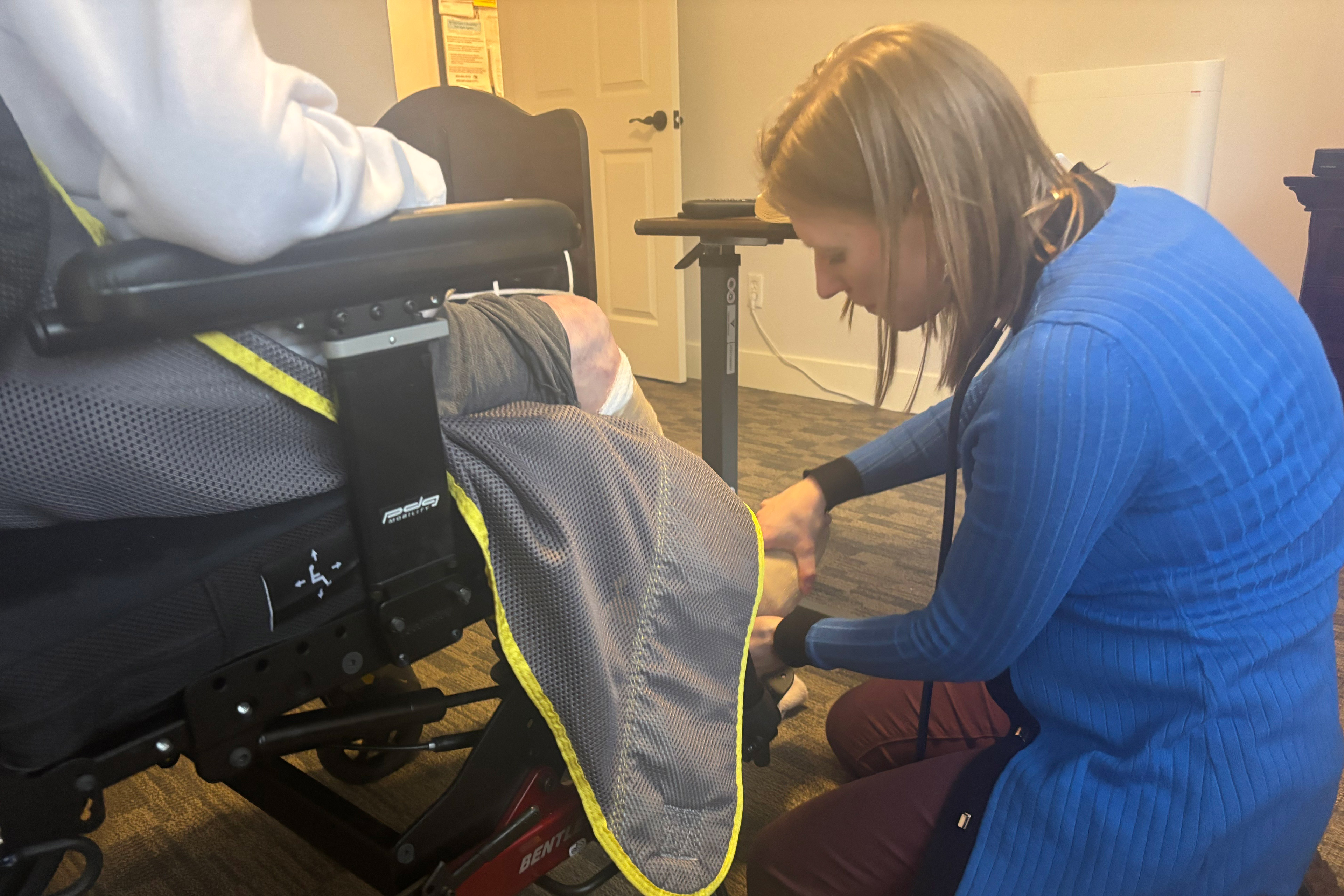
On Fridays, Stephanie Johnson has a busy schedule, driving her navy-blue Jeep from one patient’s home to the next, seeing eight in all. Pregnant with her second child, she schleps a backpack instead of a traditional black bag to carry a laptop and essential medical supplies — stethoscope, blood pressure cuff, and pulse oximeter.

Forget a lunch break; she often eats a sandwich or some nuts as she heads to her next patient visit.

On a gloomy Friday in January, Johnson, a nurse practitioner who treats older adults, had a hospice consult with Ellen, a patient in her 90s in declining health. To protect Ellen’s identity, KFF Health News is not using her last name.

“Hello. How are you feeling?” Johnson asked as she entered Ellen’s bedroom and inquired about her pain. The blinds were drawn. Ellen was in a wheelchair, wearing a white sweater, gray sweatpants, and fuzzy socks. A headband was tied around her white hair. As usual, the TV was playing loudly in the background.

“It’s fine, except this cough I’ve had since junior high,” Ellen said.

Ellen had been diagnosed with vascular dementia, peripheral vascular disease, and Type 2 diabetes. Last fall, doctors made the difficult decision to operate on her foot. Before the surgery, Ellen was always colorful, wearing purple, yellow, blue, pink, and chunky necklaces. She enjoyed talking with the half dozen other residents at her adult family home in Washington state. She had a hearty appetite that brought her to the breakfast table early. But lately, her enthusiasm for meals and socializing had waned.

Johnson got down to eye level with Ellen to examine her, assessing her joints and range of motion, checking her blood pressure, and listening to her heart and lungs.

Carefully, Johnson removed the bandage to examine Ellen’s toes. Her lower legs were red but cold to the touch, which indicated her condition wasn’t improving. Ellen’s two younger sisters had power of attorney for her and made it clear that, above all, they wanted her to be comfortable. Now, Johnson thought it was time to have that difficult conversation with them about Ellen’s prognosis, recommending her for hospice.

“Our patient isn’t just the older adult,” Johnson said. “It’s also often the family member or the person helping to manage them.”

Nurse practitioners are having those conversations more and more as their patient base trends older. They are increasingly filling a gap that is expected to widen as the senior population explodes and the number of geriatricians declines. The Health Resources and Services Administration projects a 50% increase in demand for geriatricians from 2018 to 2030, when the entire baby boom generation will be older than 65. By then, hundreds of geriatricians are expected to retire or leave the specialty, reducing their number to fewer than 7,600, with relatively few young doctors joining the field.

That means many older adults will be relying on other primary care physicians, who already can’t keep up with demand, and nurse practitioners, whose ranks are booming. The number of nurse practitioners specializing in geriatrics has more than tripled since 2010, increasing the availability of care to the current population of seniors, a recent study in JAMA Network Open found.

According to a 2024 survey, of the roughly 431,000 licensed nurse practitioners, 15% are, like Johnson, certified to treat older adults.

Johnson and her husband, Dustin, operate an NP-led private practice in greater Seattle, Washington, a state where she can practice independently. She and her team, which includes five additional nurse practitioners, each try to see about 10 patients a day, visiting each one every five to six weeks. Visits typically last 30 minutes to an hour, depending on the case.

“There are so many housebound older adults, and we’re barely reaching them,” Johnson said. “For those still in their private homes, there’s such a huge need.”

Laura Wagner, a professor of nursing and community health systems at the University of California-San Francisco, stressed that nurse practitioners are not trying to replace doctors; they’re trying to meet patients’ needs, wherever they may be.

“One of the things I’m most proud of is the role of nurse practitioners,” she said. “We step into places where other providers may not, and geriatrics is a prime example of that.”

Practice Limits

Nurse practitioners are registered nurses with advanced training that enables them to diagnose diseases, analyze diagnostic tests, and prescribe medicine. Their growth has bolstered primary care, and, like doctors, they can specialize in particular branches of medicine. Johnson, for example, has advanced training in gerontology.

“If we have a geriatrician shortage, then hiring more nurse practitioners trained in geriatrics is an ideal solution,” Wagner said, “but there are a lot of barriers in place.”

In 27 states and Washington, D.C., nurse practitioners can practice independently. But in the rest of the country, they need to have a collaborative agreement with or be under the supervision of another health care provider to provide care to older adults. Medicare generally reimburses for nurse practitioner services at 85% of the amount it pays physicians.

Last year, in more than 40 states, the American Medical Association and its partners lobbied against what they see as “scope creep” in the expanded roles of nurse practitioners and other health workers. The AMA points out that doctors must have more schooling and significantly more clinical experience than nurse practitioners. While the AMA says physician-led teams keep costs lower, a study published in 2020 in Health Services Research found similar patient outcomes and lower costs for nurse practitioner patients. Other studies, including one published in 2023 in the journal Medical Care Research and Review, have found health care models including nurse practitioners had better outcomes for patients with multiple chronic conditions than teams without an NP.

Five states have granted NPs full practice authority since 2021, with Utah the most recent state to remove physician supervision requirements, in 2023. In March, however, Mississippi House Bill 849, which would have increased NP independence, failed. Meanwhile, 30 Texas physicians rallied to tamp down full-scope efforts in Austin.

“I would fully disagree that we’re invading their scope of practice and shouldn’t have full scope of our own,” Johnson said.

She has worked under the supervision of physicians in Pennsylvania and Washington state but started seeing patients at her own practice in 2021. Like many nurse practitioners, she sees her patients in their homes. The first thing she does when she gets a new patient is manage their prescriptions, getting rid of unnecessary medications, especially those with harsh side effects.

She works with the patient and a family member who often has power of attorney. She keeps them informed of subtle changes, such as whether a person was verbal and eating and whether their medical conditions have changed.

While there is some overlap in expertise between geriatricians and nurse practitioners, there are areas where nurses typically excel, said Elizabeth White, an assistant professor of health services, policy, and practice at Brown University.

“We tend to be a little stronger in care coordination, family and patient education, and integrating care and social and medical needs. That’s very much in the nursing domain,” she said.

That care coordination will become even more critical as the U.S. ages. Today, about 18% of the U.S. population is 65 or over. In the next 30 years, the share of seniors is expected to reach 23%, as medical and technological advances enable people to live longer.

Patient and Family

In an office next to Ellen’s bedroom, Johnson called Ellen’s younger sister Margaret Watt to recommend that Ellen enter hospice care. Johnson told her that Ellen had developed pneumonia and her body wasn’t coping.

Watt appreciated that Johnson had kept the family apprised of Ellen’s condition for several years, saying she was a good communicator.

“She was accurate,” Watt said. “What she said would happen, happened.”

A month after the consult, Ellen died peacefully in her sleep.

“I do feel sadness,” Johnson said, “but there’s also a sense of relief that I’ve been with her through her suffering to try to alleviate it, and I’ve helped her meet her and her family’s priorities in that time.”

Jariel Arvin is a reporter with the Investigative Reporting Program at the University of California-Berkeley Graduate School of Journalism. He reported this article through a grant from The SCAN Foundation.

KFF Health News is a national newsroom that produces in-depth journalism about health issues and is one of the core operating programs at KFF—an independent source of health policy research, polling, and journalism. Learn more about KFF.

USE OUR CONTENT

This story can be republished for free (details).


from Health Industry Archives - KFF Health News